ERPNext Implementation in Jeddah
ERPNext Implementation in Jeddah
An imported good arrives in Jeddah carrying more than its price. It carries duty, a 15 per cent VAT on its customs value, a conformity certificate and a clearance record, and all of it belongs to the cost of the goods.
The 15 per cent VAT applied on the customs value of imports is set by the Zakat, Tax and Customs Authority; import clearance runs through the FASAH single window and the SABER conformity platform. Source checked July 2026.
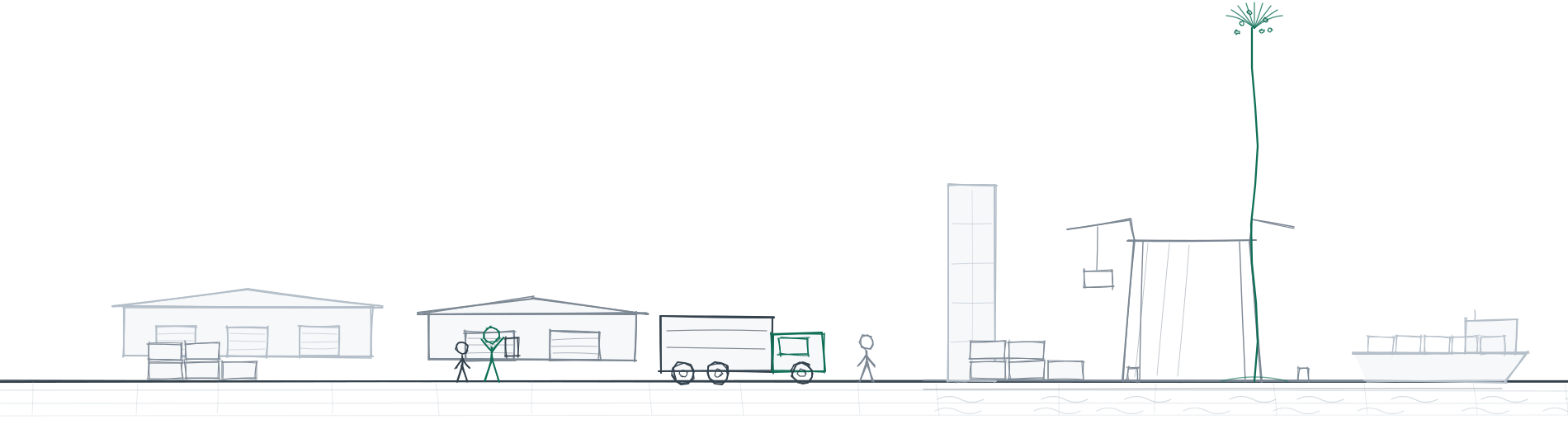
Jeddah is Saudi Arabia’s Red Sea gateway, and its businesses live on imports. That makes landed cost the number an ERPNext implementation here has to get right. A good arriving through Jeddah Islamic Port is charged 15 per cent VAT on its customs value, not on the supplier’s invoice, it may carry customs duty, and it cannot be released until it has cleared the FASAH single window and holds a SABER conformity certificate. Every one of those is a cost or a control that belongs to the goods, and a system that records only the purchase price is telling you a fraction of what the item actually cost to land.
What an ERPNext implementation in Jeddah has to solve
Start with landed cost, because the invoice price is the smallest part of it. Freight, insurance, customs duty, the 15 per cent import VAT computed on the customs value, clearing, transport and any demurrage all attach to the receipt, and they have to be apportioned across the items in it on a sensible basis. Until that is done, the margin on an imported line is a guess, and at a 15 per cent VAT rate the gap between the invoice price and the true landed cost is large enough to turn a profitable line into a loss without anyone noticing.
The second is that VAT here is charged on the customs value, not on what you paid the supplier. The customs value is its own figure, built from the transaction value plus freight and insurance to the border, and the 15 per cent is applied to that. The system has to hold the customs value alongside the purchase value and reclaim the import VAT correctly, because the two numbers are different and the return depends on the right one.
The third is release, which is a documentation gate before it is a cost. Goods do not leave the port until the FASAH single window is satisfied and, for regulated products, a SABER conformity certificate is in place. Those steps have dates and reference numbers that belong against the shipment, and a business that keeps them in a clearing agent’s email cannot reconcile what it paid to what it received. The ERP has to carry the clearance record with the goods.
Landed cost, built up not guessed
Freight, duty, the 15 per cent import VAT and clearing apportioned across the items on each import receipt, so the goods are valued and priced at what they actually cost to land in Jeddah.
Customs value, not invoice value
The customs value held alongside the purchase value, with import VAT computed on the right base and reclaimed correctly, because the two figures are not the same.
Clearance carried with the goods
FASAH single-window and SABER conformity references and dates held against the shipment, so release is reconciled to receipt rather than lost in a clearing agent’s inbox.
15% VAT that reconciles
Import VAT and domestic VAT resolved on the same records, so the return matches what actually crossed the border and what was sold on.
How we deliver in Jeddah
We start with the item master and the landed-cost model, because everything an importer values and prices depends on it. Purchase currencies, the charges that make up landed cost, the customs value alongside the invoice value, and the accounts that carry duty and import VAT. This looks like configuration and it is the whole project: get the cost build-up wrong and every margin and every return afterwards is quietly incorrect.
Then the import cycle and its documentation: purchase orders, the customs value and import VAT on receipt, FASAH and SABER references against the shipment, and reconciliation of the customs declaration, the supplier invoice and the goods received. Reporting on true landed margin and the VAT return comes last, once the transactions underneath are honest.
Typical delivery phases for a Jeddah implementation
| Phase | What happens | Why it comes here |
|---|---|---|
| 1. Discovery | Map your import charges, how customs value and duty reach your books, your FASAH and SABER steps, and how import VAT is reclaimed today. | Landed cost and import VAT depend on how clearance reaches your records. Assuming a standard build-up would misstate the margin. |
| 2. Items and costing | Item master with purchase currencies, the landed-cost template, the customs value alongside invoice value, and the accounts for duty and import VAT. | The whole margin and VAT picture rests on this, so it is agreed and built before transactions start. |
| 3. Import cycle | Purchase orders, customs value and import VAT on receipt, FASAH and SABER references against the shipment, and declaration-to-invoice-to-receipt reconciliation. | Needs a trustworthy cost model underneath before the numbers it produces mean anything. |
| 4. Margin and return | True landed margin by product and shipment, and a VAT return that reconciles import and domestic VAT. | Reporting is only worth trusting once landed cost and the customs-value base beneath it are correct. |
We avoid go-live in a peak import window and around a VAT return, because a new system, a container clearing and a return due in the same week is a risk with no upside. The peak is also when the old spreadsheet’s landed-cost gaps are least visible.
Are you ready? A short readiness check
- Do you know the true landed cost of an imported line, or only the supplier’s invoice price?
- Is the 15 per cent import VAT computed on the customs value, and reclaimed correctly?
- Are duty, VAT and clearing apportioned onto the goods, or booked to a general expense account?
- Do FASAH and SABER references sit against the shipment, or in a clearing agent’s email?
- Can you reconcile the customs declaration, the supplier invoice and what you actually received?
Four or five clear answers means you mostly need a system that keeps a discipline you already have. Two or fewer means the first phase is agreeing your landed-cost build-up and your customs-value handling, and at a 15 per cent rate that is the difference between a margin you trust and one the border quietly rewrites.
Frequently asked questions
Can ERPNext calculate landed cost on Saudi imports?
Yes. Freight, insurance, customs duty, the 15 per cent import VAT and clearing are added to a receipt and apportioned across its items, so the goods are valued at what they cost to land rather than at the supplier’s invoice line.
How is VAT on the customs value handled?
The customs value is held alongside the purchase value, and import VAT at 15 per cent is computed on that base and treated so it can be reclaimed correctly. The two figures are kept distinct because the return depends on the right one.
Can it hold FASAH and SABER clearance records?
Yes. The single-window and conformity references and dates are held against the shipment, so release is reconciled to receipt and the clearance history sits with the goods rather than in an inbox.
Does the VAT return reconcile import and domestic VAT?
Yes, because both are resolved on the same records. Import VAT reclaimed on receipt and VAT charged on the onward sale flow into the same return, so it matches what crossed the border and what was sold.
How long does an ERPNext implementation take for a Jeddah importer?
Ten to sixteen weeks for a single importing and distribution business with a settled landed-cost model, longer where charge structures differ widely across product lines or where clearance data has to be brought in from spreadsheets. That cleanup is the part that makes landed cost real.
Key takeaways for Jeddah businesses
- In Jeddah the invoice price is the smallest part of an import. Freight, duty, 15 per cent VAT and clearing all belong on the receipt.
- Saudi VAT is charged on the customs value, not the supplier invoice. Hold both figures or the return uses the wrong base.
- FASAH and SABER are release gates with references that belong against the shipment, not in a clearing agent’s email.
- At a 15 per cent rate, the gap between invoice price and landed cost is large enough to hide a loss. Build the cost up, do not guess it.
Planning ERPNext for a Jeddah importer or distributor?
Start your ERPNext implementation with a team that will settle landed cost and customs-value VAT before it prints a margin report. KlyONIX Tech™ is a Frappe Certified Partner with offices in Pollachi and Chennai, delivering, onboarding and supporting clients in Saudi Arabia remotely.
The 15 per cent VAT rate, applied on the customs value of imported goods, is set by the Zakat, Tax and Customs Authority; import clearance is processed through the FASAH national single window, and regulated products require a SABER conformity certificate issued under the Saudi Standards, Metrology and Quality Organization. Customs value is built from the transaction value plus freight and insurance to the point of entry. These are national Saudi rules; Jeddah Islamic Port is the Kingdom’s principal Red Sea gateway through which much of that import trade clears. Source checked July 2026.
ERPNext in Riyadh · ERPNext in Colombo · ERPNext in Dubai · ERPNext implementation cost