ERPNext Implementation in Surat
A rough stone goes out to a karigar heavier than it comes back. The weight it loses in the cutting is not waste; it is the single number that decides whether the packet made money.
World share and export figures from the Gem & Jewellery Export Promotion Council (GJEPC), sponsored by the Ministry of Commerce and Industry. Surat accounts for the overwhelming majority of India’s cutting and polishing. Source checked July 2026.
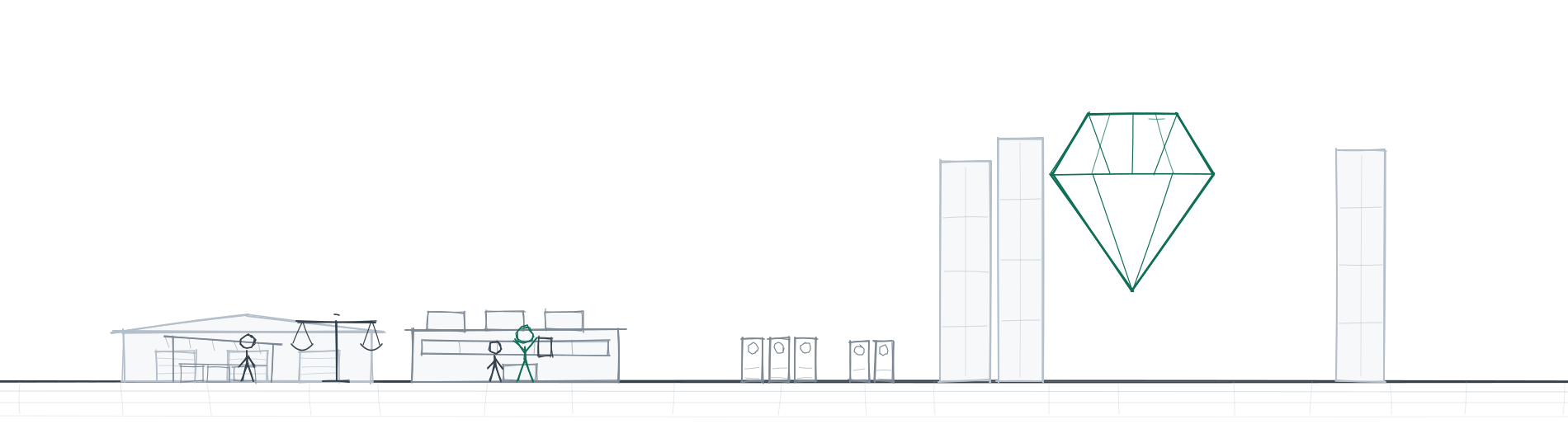
Surat cuts and polishes about nine of every ten diamonds in the world, and India, driven almost entirely by Surat, ships three quarters of the world’s polished stones by value, US dollars 13.3 billion in 2024-25 on GJEPC figures. That trade runs on a fact most accounting systems cannot hold: a diamond is heavier as rough than it is as a polished stone, it passes through several sets of hands, and much of that work is done outside your walls by karigars paid per stone. An ERPNext implementation in Surat is judged on whether it can follow a packet through that journey and tell you, honestly, what each stone cost and yielded.
What an ERPNext implementation in Surat has to solve
Start with yield, because it is the whole game. A rough stone is issued by weight in carats, and it comes back polished at a fraction of that weight after sawing, bruting and polishing. The weight lost is real and it varies by stone, by rough quality and by the cutter’s skill. The cost per polished carat is meaningless unless the system holds both the issued rough weight and the returned polished weight and treats the loss as what it is: the yield that decides the margin. A standard recovery percentage applied to every packet is a way of not knowing.
The second is the journey and the hands it passes through. A packet moves through sawing, bruting and polishing, and much of that is job-work issued to karigars who take stones out of your premises and bring them back changed. Material issued has to be reconciled against material returned, by weight and by count, at every stage, because this is exactly where unrecorded loss and dispute live. The system has to account for every stone at every hand-off, not just at the ends.
The third is realisation, which is by the four Cs and by the packet. The polished output of one rough is not one thing; it is an assortment that grades out across colour, clarity, cut and carat, and each grade realises a different price. Karigars are paid by the piece or by the stone, so labour attaches to the packet too. Profit is grade-wise realisation set against the rough cost, the yield and the cutting labour, and none of it is visible if the system stops at the word diamond.
Weight-loss yield, per packet
Rough carats issued and polished carats returned held against the same packet, so the loss in cutting is the measured yield it actually was, not a standard recovery that flatters a bad stone.
Every stone reconciled at every hand-off
Material issued to karigars for sawing, bruting and polishing reconciled by weight and count on return, so unrecorded loss has nowhere to hide between stages.
Assortment by the four Cs
Polished output graded across colour, clarity, cut and carat, each grade carrying its own realisation, so a rough splits into the grades you actually produced rather than one figure.
Piece-rate labour on the packet
Karigar wages, by stone or by piece, attached to the packet they worked, so cutting labour sits in the cost of the polished stone rather than in a payroll total.
How we deliver in Surat
We start with the packet and the yield model, because a diamond business is organised around the stone and its weight, not around a warehouse. The rough carat issue, the polished carat return, the loss as yield, and the job-work issue and reconciliation to karigars at each stage. This looks like configuration and it is the whole project: get the weight and yield capture wrong and every cost per carat afterwards is a guess with decimals.
Then the assortment and the sale: polished output graded across the four Cs, piece-rate labour attached to the packet, and realisation by grade set against rough cost, yield and labour. Reporting on cost per polished carat, on yield by cutter and rough type, and on packet profitability comes last, once the stone-level capture underneath it is honest.
Typical delivery phases for a Surat implementation
| Phase | What happens | Why it comes here |
|---|---|---|
| 1. Discovery | Map how rough is issued, how job-work goes to karigars and returns, how polished is assorted and graded, and how labour is paid. | Every diamond house tracks weight and job-work differently. Assuming a standard flow would misstate the one number that matters, yield. |
| 2. Packet and yield | Rough issue by weight, polished return by weight, the loss as yield, and job-work issue and reconciliation by weight and count. | The whole costing rests on stone-level weight capture, so it is built and agreed before anything else. |
| 3. Assortment and labour | Polished graded across the four Cs, piece-rate karigar labour attached to the packet, and each grade held as its own stock. | Needs a trustworthy yield and job-work base underneath before grade realisation means anything. |
| 4. Cost and margin | Cost per polished carat, yield by cutter and rough type, and packet profitability by grade. | Reporting is only worth trusting once weight, yield and labour beneath it are captured honestly. |
We avoid go-live around Diwali, when the karigars go home and the units all but close, and we prove the weight and job-work capture on live packets before trusting it. In a business where a missing point of a carat is money, the capture is proven twice before it is relied on once.
Are you ready? A short readiness check
- Do you record both the rough weight issued and the polished weight returned for a packet, or only one?
- Is your cutting yield measured per packet, or applied as a standard recovery percentage?
- When stones go to a karigar and come back, are they reconciled by weight and count?
- Is polished output graded across the four Cs and held as separate stock by grade?
- Is karigar labour attached to the packet it worked, or paid as a lump each week?
Four or five clear answers means you mostly need a system that keeps a discipline you already run on the floor. Two or fewer means the first phase is capturing weight, yield and job-work properly, and in this trade that is the difference between a cost per carat you trust and one you argue about.
Frequently asked questions
Can ERPNext track a diamond packet from rough to polished?
Yes. A packet carries its issued rough weight and its returned polished weight, and the difference is held as the cutting yield rather than written off. The packet moves through sawing, bruting and polishing with the weight captured at each stage.
How is job-work to karigars handled?
As material issued to a third party by weight and count and reconciled on return, so what went out and what came back are matched at every stage. That reconciliation is usually where unrecorded loss and dispute have been sitting.
Can it grade polished output by the four Cs?
Yes. Polished stones are assorted and held as stock by colour, clarity, cut and carat, each grade carrying its own valuation and realisation, so a single rough splits into the grades you actually produced and sold.
How is piece-rate karigar labour costed?
By attaching the wage, per stone or per piece, to the packet it was earned on, so cutting labour sits in the cost of the polished stone rather than in a weekly payroll figure disconnected from the work.
How long does an ERPNext implementation take for a Surat diamond business?
Ten to eighteen weeks for a cutting and polishing unit with job-work and assortment, because weight, yield and job-work capture all have to be modelled and proven. A pure trading house is faster; the variable is the floor capture, not the software.
Key takeaways for Surat businesses
- In Surat the weight a diamond loses in cutting is the yield, and the yield is the margin. Hold rough and polished weight or the cost per carat is fiction.
- Most of the work is job-work to karigars. Reconcile stones by weight and count at every hand-off or loss hides between stages.
- A rough polishes into an assortment across the four Cs. Realisation is grade-wise, so stopping at the word diamond hides the margin.
- Karigar labour is piece-rate and belongs on the packet, not in a payroll total disconnected from the stones it cut.
Planning ERPNext for a Surat diamond or textile business?
Start your ERPNext implementation with a team that will capture weight, yield and job-work before it prints a cost per carat. KlyONIX Tech™ is a Frappe Certified Partner with offices in Pollachi and Chennai, working with manufacturers across Gujarat and western India.
Surat’s share of world diamond cutting and polishing, India’s share of world polished exports by value, and the 2024-25 export figure of US dollars 13.3 billion are from the Gem & Jewellery Export Promotion Council (GJEPC), the export promotion body sponsored by the Ministry of Commerce and Industry. Surat accounts for the overwhelming majority of India’s cutting and polishing capacity and is also India’s largest man-made fabric centre, the second sector referenced here. Source checked July 2026.
ERPNext in Ahmedabad · ERPNext in Jaipur · ERPNext in Tiruppur · ERPNext implementation cost