ERPNext for Pharma CDMO and Contract Manufacturing
A CDMO is two businesses wearing one roof. One sells science by the project, the other sells capacity by the batch, and they meet at tech transfer. Most systems are built for the second and quietly pretend the first is a spreadsheet.
The United States BIOSECURE Act was enacted in December 2025 within the FY2026 National Defense Authorization Act, restricting federal dealings with named biotechnology providers of concern and accelerating a China-plus-one shift in outsourcing; India hosts roughly 650 USFDA-registered plants, about a quarter of all such facilities outside the United States. Source checked July 2026.
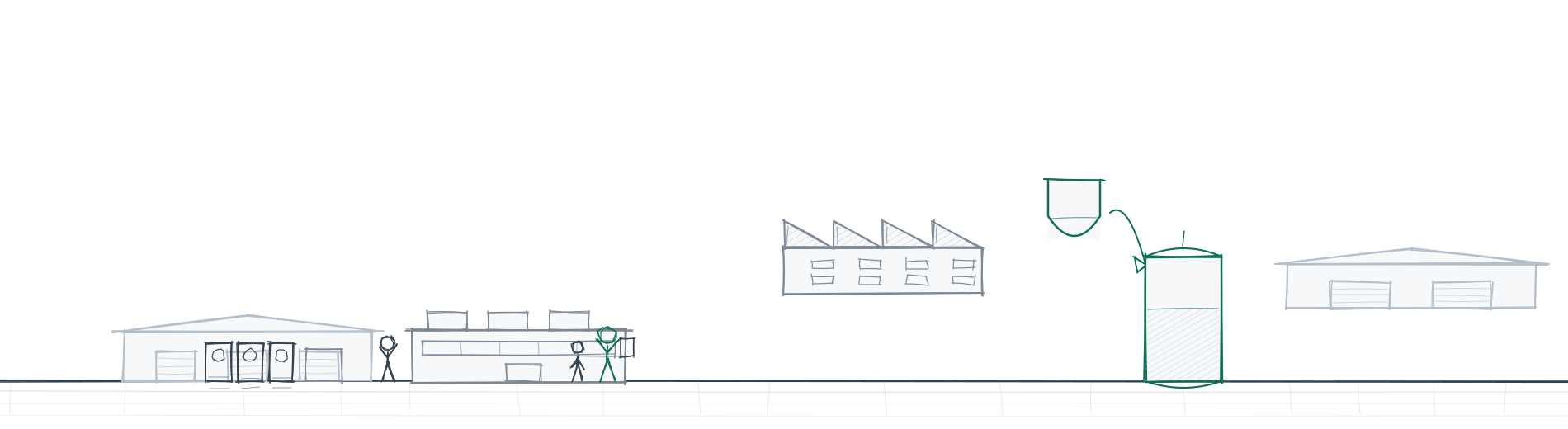
A contract development and manufacturing organisation sells two different things to the same client. It sells development, which is people, time, trials and a process that did not exist before, and it sells manufacture, which is capacity, batches and conversion. Between them sits tech transfer, where a process that worked at laboratory scale has to survive a production vessel. Demand for that combination is moving toward India: the BIOSECURE Act is now United States law, and the China-plus-one reflex it accelerates lands on a country with roughly 650 USFDA-registered plants. ERPNext for a CDMO is judged on whether it can run the project side and the batch side in one system, carry a process cleanly across tech transfer, and keep every client separate while telling you which of them you actually make money on.
What a CDMO has to solve that a single-product plant does not
Start with the fact that development is not manufacturing. A development programme is a project: scientist time, trial batches that may fail, analytical work, materials consumed proving something rather than shipping it, and milestones the client is invoiced against. None of that behaves like a production order. The system has to run development as a project with its own costs and billing, because a CDMO that cannot cost its development work is giving away the part of the business that wins the manufacturing contract.
The second is tech transfer, which is where CDMOs actually lose money. A process defined in development becomes a controlled master for commercial manufacture, and in the move the batch size changes, the equipment changes and the yield changes with them. If the transfer is a document handed between teams, the commercial standard is somebody’s optimistic memory of a laboratory result. The system has to carry the process from development into a controlled manufacturing master, with the scale-up assumptions visible, because the first commercial campaign is a very expensive place to discover the yield was never real.
The third is that every client must be sealed off, and every client must be measurable. Their materials, their specifications, their batches and their intellectual property cannot mingle, and one client’s material must never be consumed on another’s batch. At the same time you need to know, across both development and manufacture, which clients are profitable. The system has to keep clients separate in operations and comparable in reporting, because a CDMO without per-client profitability is negotiating its next contract blind.
Development run as a project
Scientist time, trial batches, analytical work and materials costed to a development programme, and milestones invoiced against it, because development is a project and not a production order.
Tech transfer that survives scale-up
The developed process carried into a controlled manufacturing master with its scale-up assumptions visible, so the first commercial campaign meets a standard someone actually derived.
Clients sealed off from each other
Each client’s materials, specifications, batches and documents separated, so one principal’s material can never be consumed on another’s batch.
Profitability per client, both sides
Development and manufacturing margin brought together per client, so you know which relationships pay and which are subsidised before you price the next one.
How we deliver CDMOs on ERPNext
We start by separating the two businesses and then joining them properly. Development as a project carrying its own time, trial batches and materials, commercial manufacture as batches with conversion billed as job-work, and each client’s stock and specifications walled off. This looks like configuration and it is the whole point: run development inside the manufacturing module and you will either lose the cost of your science or corrupt your batch records with trials that never shipped.
Then tech transfer and reporting: the developed process promoted into a controlled manufacturing master with its scale-up assumptions recorded, and profitability reported per client across both sides. The reporting is only worth trusting once the project costs and the batch costs beneath it are captured honestly, because a per-client margin assembled from two disconnected systems is an estimate wearing the clothes of a number.
A client’s journey through a CDMO
| Stage | What happens | What the system has to hold |
|---|---|---|
| Enquiry and feasibility | A prospective client brings a molecule, a process or a problem. | The enquiry costed against real capacity and capability before anyone promises a date. |
| Development programme | Scientist time, trial batches, analytical work, iterations that may fail. | A project accumulating its own cost, with milestones invoiced as they are met. |
| Tech transfer and scale-up | The process moves from development scale to a production vessel. | A controlled manufacturing master derived from development, with scale-up assumptions visible. |
| Commercial manufacture | Repeat batches made to the client’s specification, often on their materials. | Batch records, client-owned stock held separately, and conversion billed as job-work. |
We prove the development project and the tech transfer on one real client before scaling the model, because a CDMO that gets the transfer wrong discovers it in the first commercial campaign, at the client’s expense and its own. The two sides are joined early, because per-client profitability is meaningless until both halves are captured in the same place.
Development-led or manufacturing-led? It changes what you build first
If most of your revenue is repeat commercial manufacture, and development is occasional, build the manufacturing side properly first: client-owned stock, batch records per client, and conversion billed as job-work. That is the loan-licence and third-party pattern, and our Baddi page covers it in detail.
If development is a genuine revenue line, and clients arrive with molecules rather than with purchase orders, the project side has to be real from day one. Otherwise the science is costed by feel, the transfer into manufacturing is a handover email, and you will find out which clients were worth having only after the contracts are signed.
Are you ready? A short readiness check
- Is development run as a costed project, or absorbed into overhead and hoped for?
- When a process moves from development to commercial, does it become a controlled master with its scale-up assumptions recorded?
- Are each client’s materials, specifications and batches genuinely separated in the system?
- Can one client’s material ever be consumed on another client’s batch?
- Can you show profitability per client across development and manufacturing together?
Four or five clear answers means you are running a CDMO rather than a plant that also does projects. Two or fewer means the first phase is the project side and tech transfer, and for a CDMO taking on new clients that is the difference between growth that compounds and growth that quietly costs you money.
Frequently asked questions
Why does a CDMO need more than a manufacturing ERP?
Because roughly half the business is not manufacturing. Development is project work with its own costs, failures and milestone billing, and it has to sit in the same system as the batches so that per-client profitability means something. A manufacturing-only setup either loses the development cost or pollutes the batch records with trials.
How should tech transfer be handled in the system?
The process developed for a client is promoted into a controlled manufacturing master, with the scale-up assumptions and the derived standard yield recorded rather than remembered. That way the first commercial campaign is measured against a standard someone actually derived, and any variance is a real signal.
Can ERPNext keep client work genuinely separate?
Yes. Each client’s materials, specifications, batches and documents are held separately, client-owned stock is tracked as theirs rather than yours, and consumption is constrained so one client’s material cannot be used on another’s batch.
Does the BIOSECURE Act actually change anything operationally?
It changes demand rather than compliance for an Indian CDMO. As United States sponsors reduce reliance on named Chinese providers, enquiries move toward alternative suppliers. The operational consequence is onboarding: more new clients, more tech transfers, and more scrutiny of how cleanly you separate and document their work.
How long does an ERPNext implementation take for a CDMO?
Twelve to twenty weeks typically, because both the project side and the batch side have to be modelled and joined, and tech transfer proven on a live client. A pure contract manufacturer without a development line is faster; the development and multi-client depth is the variable.
Key takeaways
- A CDMO runs two businesses in one plant. Development is a project, manufacture is a batch, and a system built only for the second will lose the cost of the first.
- Tech transfer is where the money leaks. Carry the process into a controlled master with its scale-up assumptions visible, rather than handing over a document.
- Client separation is operational, not just contractual. One client’s material must never be consumable on another’s batch.
- BIOSECURE and China-plus-one are moving enquiries toward India. The constraint on winning them is usually onboarding discipline, not capacity.
Planning ERPNext for a CDMO or contract manufacturer?
Start with a team that will build your development projects and your batch records into one system before it reports a margin. KlyONIX Tech™ is a Frappe Certified Partner working with contract manufacturers and pharmaceutical businesses across India.
The United States BIOSECURE Act was enacted in December 2025 as part of the FY2026 National Defense Authorization Act, restricting federal contracting with named biotechnology providers of concern and accelerating China-plus-one diversification in pharmaceutical outsourcing; India hosts roughly 650 USFDA-registered manufacturing sites, about a quarter of all such facilities outside the United States, and its CDMO sector is widely projected to grow at a low-teens compound rate through the early 2030s. Source checked July 2026.
ERPNext for Pharmaceutical · ERPNext for pharma formulations · ERPNext in Baddi · ERPNext in Goa