ERPNext Implementation in Ankleshwar
An API batch is a chemical reaction, not an assembly. You charge solvents and intermediates, run the reaction, and the yield is whatever chemistry gives back that day, never a fixed number. What the plant has to know is where every kilogram went: into product, into recovery, or into effluent.
Ankleshwar sits in Bharuch district, Gujarat, one of India’s largest bulk-drug and chemical belts on the GIDC estates, and Gujarat holds one of the three Department of Pharmaceuticals Bulk Drug Parks, sanctioned on 2,015 acres at Jambusar in Bharuch district. Source checked July 2026.
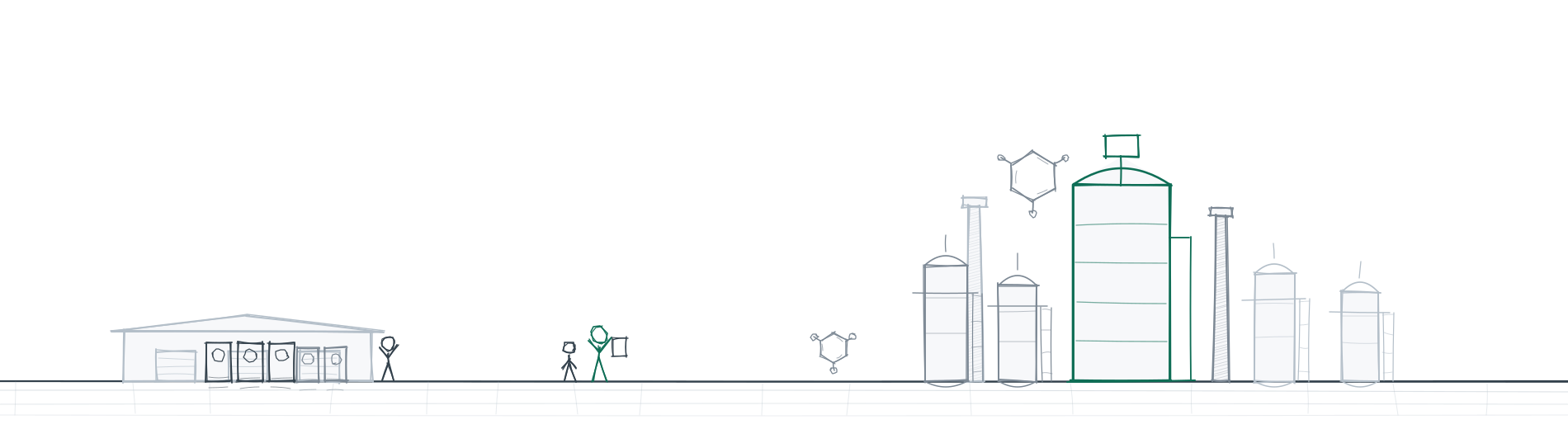
Ankleshwar, with Bharuch and the wider GIDC belt, is one of India’s densest clusters of active pharmaceutical ingredients, intermediates and fine chemicals. The work here is chemistry: a batch is reacted from solvents and intermediates, and the finished kilograms are whatever the reaction and the recovery yield, not a number fixed in advance. An ERPNext implementation in Ankleshwar is judged on whether it can hold a mass balance rather than a simple bill of materials, carry the genealogy of a batch through campaigns, and account for solvent recovery and effluent rather than pretending every input becomes product.
What an ERPNext implementation in Ankleshwar has to solve
Start with yield, because an API batch does not have a fixed one. You charge a reactor with solvents and intermediates, run the reaction, and recover a quantity that moves batch to batch with the chemistry, the temperature and the operator. The system has to plan against a standard yield but record the actual one every batch, and hold a mass balance, because a bill of materials that assumes a kilogram in becomes a kilogram out is describing an assembly line, not a reaction.
The second is genealogy through a campaign, because APIs are made in runs. A plant often makes one product for weeks, then cleans down and switches, and each batch of finished API traces back through intermediates to the specific lots of raw material and solvent that made it. The system has to carry that genealogy forward and back, because a customer query or a regulatory filing asks which raw lots are in which finished batch, and the answer cannot be a week of reconstruction.
The third is recovery and effluent, because a lot of what enters a reactor is not product. Solvent is recovered and re-used, some material leaves as effluent, and the difference is both a cost and a compliance number. The system has to account for recovered solvent as stock with a value, and for loss as loss, because a plant that books every input straight to product misstates its yield, its cost and its environmental position all at once.
A mass balance, not a parts list
Every batch planned against a standard yield but recorded at its actual, with inputs, product, recovery and loss reconciled, because an API is reacted and recovered rather than assembled.
Batch genealogy through campaigns
Finished API traced back through intermediates to the exact raw-material and solvent lots, forward and back, so a customer or regulatory query is answered from the record, not rebuilt.
Solvent recovery and effluent, valued
Recovered solvent held as stock with a value and re-used, loss booked as loss, so yield, cost and the environmental number are all honest rather than hidden in a single output figure.
Ready for the filing and the audit
Batch records, yields and genealogy captured as the campaign runs, so a DMF query or an inspection is met with the record as it was made, not a reconstruction after the fact.
How we deliver in Ankleshwar
We start with yield and mass balance, because on an API they are the process. Standard yield to plan against, actual yield recorded every batch, and inputs reconciled against product, recovery and loss. This looks like configuration and it is the whole point: run a reaction on a fixed bill of materials and you will overstate what you made, mis-cost it, and lose the trail a filing needs.
Then genealogy and recovery: the batch traced through intermediates to raw and solvent lots, recovered solvent valued and returned to stock, and effluent booked as loss. Reporting on yield, cost per batch and traceability comes once the mass balance and genealogy beneath them are captured honestly, because a yield report is only as true as the balance it is drawn from.
Typical delivery phases for an Ankleshwar implementation
| Phase | What happens | Why it comes here |
|---|---|---|
| 1. Discovery | Map how batches are charged and reacted, how yield actually behaves, how genealogy runs through campaigns, and how solvent recovery and effluent are accounted for today. | API chemistry is unlike assembly. Assuming a fixed bill of materials would overstate output and lose the mass balance a filing and an auditor rely on. |
| 2. Yield and mass balance | A standard yield to plan against, actual yield recorded per batch, and inputs reconciled against product, recovered solvent and loss. | The mass balance is the foundation every other number reads, so it is built and agreed before genealogy or costing mean anything. |
| 3. Genealogy and recovery | Batch genealogy through intermediates to raw and solvent lots, recovered solvent valued back into stock, and effluent booked as loss. | Needs a trustworthy mass balance underneath before a trace, a cost or a recovery figure can be believed. |
| 4. Cost, filing and reporting | Cost per batch from real inputs and yield, and batch records and genealogy ready for a DMF query or an inspection. | Reporting and filings are only worth trusting once the yield, balance and genealogy beneath them are captured as the campaign runs. |
We prove the mass balance and genealogy on a live campaign before trusting them, because on an API a wrong yield or a broken trail is discovered at a costing or a filing, when it is hardest to fix. In bulk-drug chemistry the balance is proven early, because you cannot reconcile a reaction after the solvent has been recovered and the effluent has gone.
Are you ready? A short readiness check
- Do you plan against a standard yield but record the actual yield of every API batch?
- Can you reconcile a batch as a mass balance, inputs against product, recovery and loss?
- Can you trace a finished batch back through intermediates to the exact raw and solvent lots?
- Is recovered solvent held as valued stock and re-used, and effluent booked as loss?
- Can you produce a batch record and genealogy for a DMF query or an inspection without rebuilding it?
Four or five clear answers means you mostly need a system that keeps a discipline your process and QA already run. Two or fewer means the first phase is yield and mass balance, and on an API that is the difference between a cost and a filing you can stand behind and a number you hope holds up.
Frequently asked questions
Can ERPNext handle an API batch where yield is not fixed?
Yes. Each batch is planned against a standard yield but records its actual yield, and the batch is reconciled as a mass balance of inputs against product, recovered solvent and loss, so the record reflects the chemistry rather than an assumed one-to-one conversion.
How does it trace genealogy through a campaign?
Finished API is traced back through its intermediates to the specific raw-material and solvent lots that made it, forward and back, so a customer or regulatory query is answered from the record instead of reconstructed.
Can it account for solvent recovery and effluent?
Yes. Recovered solvent is held as stock with a value and returned to use, while loss is booked as loss, so yield, cost per batch and the environmental figure are all drawn from the same honest balance.
Is it ready for a DMF query or an inspection?
Batch records, yields and genealogy are captured as the campaign runs, so a filing query or an audit is met with the record as it was made rather than a document assembled afterwards.
How long does an ERPNext implementation take for an Ankleshwar API plant?
Twelve to twenty weeks for a bulk-drug or intermediate manufacturer, because yield, mass balance, genealogy and recovery all have to be modelled and proven on a live campaign. A simpler formulation plant is faster; the process-chemistry depth is the variable, not the software.
Key takeaways for Ankleshwar businesses
- In Ankleshwar an API is reacted, not assembled, so a mass balance and an actual yield per batch replace a fixed bill of materials.
- APIs are made in campaigns, so genealogy from finished batch back to raw and solvent lots has to run both ways for a customer query or a filing.
- A lot of what enters a reactor is not product. Value recovered solvent as stock and book loss as loss, so yield and cost stay honest.
- Capture yield, balance and genealogy as the campaign runs, so a DMF query or an inspection is met with the record, not a reconstruction.
Planning ERPNext for an Ankleshwar API plant?
Start your ERPNext implementation with a team that will build your mass balance and batch genealogy before it prints a yield report. KlyONIX Tech™ is a Frappe Certified Partner with offices in Pollachi and Chennai, working with bulk-drug, chemical and manufacturing businesses across Gujarat and western India.
Ankleshwar, in Bharuch district, Gujarat, anchors one of India’s densest bulk-drug, intermediate and fine-chemical belts on the GIDC estates; Gujarat holds one of the three Department of Pharmaceuticals Bulk Drug Parks, sanctioned on 2,015 acres at Jambusar in Bharuch district under the national Promotion of Bulk Drug Parks scheme. Source checked July 2026.
ERPNext in Baddi · ERPNext in Hyderabad · ERPNext in Ahmedabad · ERPNext implementation cost