ERPNext Implementation in Delhi NCR
Your customers think you are one company in one city. Your filings know you are several companies, in four states.
Constituent area figures from the NCR Planning Board, a statutory body under the National Capital Region Planning Board Act 1985. Areas are as notified in April 2018: NCT Delhi plus fourteen districts of Haryana, eight of Uttar Pradesh and two of Rajasthan. Source checked July 2026.
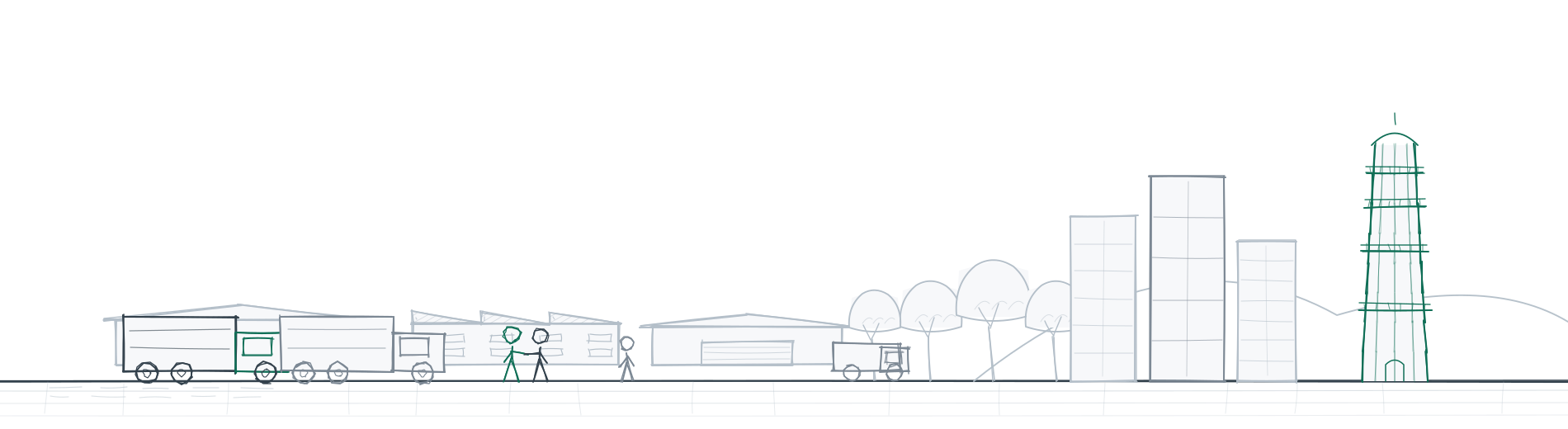
Delhi NCR is not a city. The NCR Planning Board notifies it as NCT Delhi plus twenty-four districts across Haryana, Uttar Pradesh and Rajasthan, covering 55,083 square kilometres. A business here routinely has its registered office in Delhi, a warehouse in Ghaziabad and a plant in Gurugram, thirty kilometres apart and in three different tax jurisdictions. That single fact shapes the entire implementation.
What an ERPNext implementation in Delhi NCR has to solve
Start with the obvious consequence. Each state you hold stock in needs its own GST registration, and a movement between two of your own locations across a state line is a supply, not an internal note. It needs a tax invoice, it needs an e-way bill, and it lands in a different return. Businesses that grew up thinking of NCR as one place are frequently surprised to find they have been under-documenting movements they made every week for years.
The second consequence is structural, and it is the one that actually decides whether the implementation succeeds. Most established NCR groups are not one company. They are three or four legal entities, often split by activity and partly by history: a trading company, a manufacturing company, sometimes a separate services or property entity. They buy and sell from each other. Those inter-company transactions have to be recorded as real transactions and then eliminated when you want a group picture, and no single entity’s books can produce that picture.
The third is the quiet one. Costs get shared across entities in ways nobody has written down. The same finance team, the same warehouse, the same directors, the same software licences, invoiced to whichever entity had cash that month. The allocation basis is a commercial decision you have to make, not something we can infer from your data. Until it is decided, entity-level profitability is a number people argue about rather than act on.
One registration per state, not one per company
Warehouses in Delhi, Haryana and Uttar Pradesh mean three registrations, three sets of returns and stock transfers between them treated as supplies. Modelled once at the start, this is routine. Retrofitted later, it means restating history.
A related-party sale is still a sale
Inter-company transactions carry invoices, tax and documentation like any other, and they have to be identifiable so they can be eliminated on consolidation. Netting them off informally is what makes group numbers impossible to audit.
Consolidation as a report, not a spreadsheet
A group P&L and balance sheet built from the entity ledgers, with inter-company eliminations applied by rule. If the group view only exists in a workbook on one person’s laptop, it is not a system, it is a dependency.
Shared costs need a defensible basis
Headcount, revenue, floor area, transaction volume: any of these can be right. What matters is that the basis is chosen deliberately, written down and applied consistently, so entity margins mean the same thing each month.
How we deliver in Delhi NCR
We start by drawing the actual legal and physical map: which entities exist, what each one does, where stock physically sits, which registrations are live, and which movements cross a state line. This usually takes longer than clients expect and it is the highest-value week of the project, because every later decision inherits it.
Then the chart of accounts and the entity structure, so consolidation is designed in rather than bolted on. After that, stock and multi-state tax: warehouse structure, transfers, e-way bill data coming off the despatch rather than being retyped, and returns per registration. Inter-company workflows, shared-cost allocation and group reporting come last, once the individual entities are clean.
Typical delivery phases for a Delhi NCR implementation
| Phase | What happens | Why it comes here |
|---|---|---|
| 1. Discovery | Map entities, locations, GST registrations, inter-company flows and which stock movements cross a state line. | Everything downstream inherits this map, and getting it wrong is expensive to unwind. |
| 2. Structure and books | Entity setup, chart of accounts designed for consolidation, cost centres, shared-cost allocation basis. | Consolidation has to be designed in. Bolted on later it is a spreadsheet, not a system. |
| 3. Stock and tax | Warehouse structure per state, inter-state transfers as supplies, e-way bill data from the despatch, returns per registration. | Needs the entity and location map settled before it can be configured safely. |
| 4. Group reporting | Inter-company elimination, group P&L and balance sheet, entity-wise and location-wise margin. | Only defensible once each entity’s own books reconcile on their own. |
We avoid go-live in the week before a GST return deadline, and we avoid the financial year end. With several registrations to file, a new system and a filing deadline in the same week is a risk with no upside.
Are you ready? A short readiness check
- How many legal entities does the group actually have, and does each one have its own complete set of books?
- How many GST registrations are live, and does each state where you hold stock have one?
- When stock moves from your Ghaziabad warehouse to your Gurugram plant, what document is raised?
- Can you produce a consolidated group P&L without opening a spreadsheet?
- Is there a written basis for how shared costs are split between entities?
Four or five clear answers means the implementation is mostly configuration. Two or fewer means the first phase is structural work on entities, registrations and allocation, and that work is worth doing properly before anyone touches a screen.
Frequently asked questions
Can ERPNext handle several companies in one system?
Yes. Multiple companies sit in one instance with their own charts of accounts, and consolidated reporting runs across them. Inter-company transactions can be recorded and identified so they are eliminated in the group view.
How does it handle GST registrations in three states?
Each place of business carries its own registration details, and transactions pick up the right one based on the location involved. Inter-state stock transfers between your own warehouses are treated as supplies, with the tax invoice and e-way bill data generated from the despatch.
Does it generate e-way bills?
It holds and structures the data an e-way bill needs so it comes off the despatch document rather than being retyped into a portal. The actual generation goes through the government portal or a GSP; the point of the ERP is that the numbers match what physically left the warehouse.
How is a group P&L produced?
As a consolidated report across the companies in the instance, with inter-company balances eliminated by rule. The elimination logic has to be agreed with your auditor, and we implement what you agree rather than deciding it for you.
How long does an ERPNext implementation take in Delhi NCR?
Ten to eighteen weeks for a group with three or four entities and registrations in two or three states. A single entity in one state is considerably faster. The variable is almost always the structural work, not the software.
Key takeaways for Delhi NCR businesses
- NCR is one market and four tax jurisdictions. A thirty kilometre stock movement can still be an inter-state supply.
- If the group is several companies, consolidation has to be designed into the chart of accounts, not reconstructed in a spreadsheet afterwards.
- Inter-company transactions are real transactions. Record them properly and eliminate them by rule.
- The basis for splitting shared costs is your decision. Until it is written down, entity profitability is an argument rather than a number.
Planning ERPNext for a Delhi NCR business or group?
Start your ERPNext implementation with a team that will map your entities and registrations before it configures anything. KlyONIX Tech™ is a Frappe Certified Partner with offices in Pollachi and Chennai, working with clients across northern India.
Constituent area, district counts and total area from the NCR Planning Board, a statutory body constituted under the National Capital Region Planning Board Act 1985 and working under the Ministry of Housing and Urban Affairs. Figures are the notified constituent areas as at April 2018, which is the most recent notification published on that page; the Board itself notes that an updated map is yet to be prepared. The district counts are Haryana fourteen, Uttar Pradesh eight and Rajasthan two, plus the whole of NCT Delhi. Source checked July 2026.
ERPNext in Mumbai · ERPNext in Jaipur · ERPNext in Kolkata · ERPNext implementation cost