ERPNext Implementation in Madurai
KlyONIX Tech™ is a Frappe Certified Partner delivering ERPNext implementation, customization and support for Madurai businesses across Tamil Nadu, on time and on budget.
MSME sector counts from Madurai District Administration and the DC-MSME district industrial profile. The corridor value is a projected investment figure, not committed capital. Source checked July 2026.
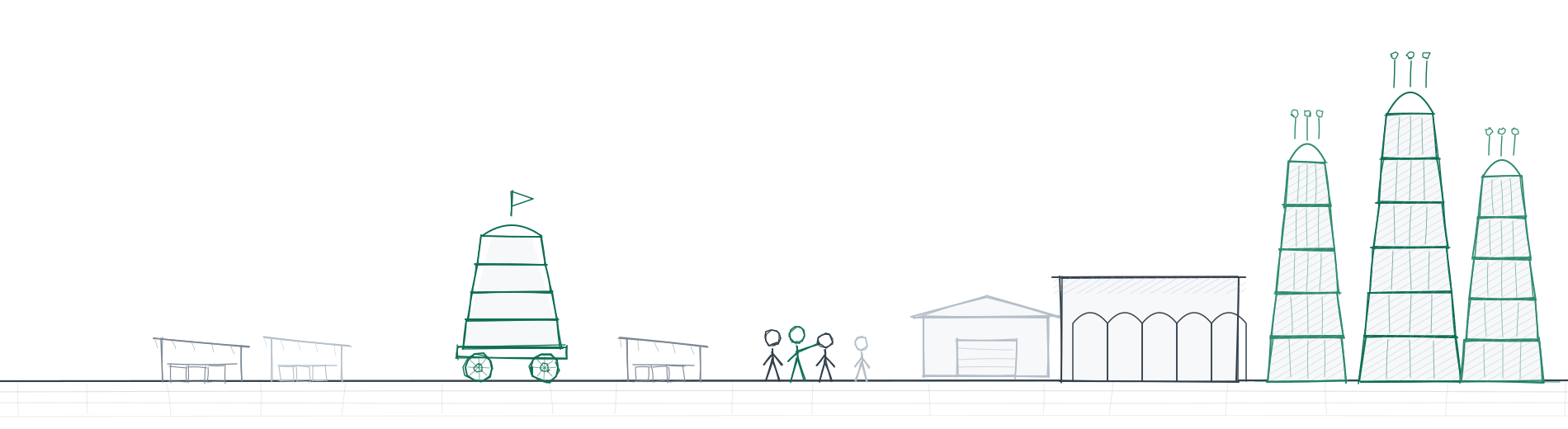
Madurai is not an export cluster and it is not a single-industry town. It is the trading and manufacturing centre for southern Tamil Nadu, which means most businesses here sell to hundreds of small buyers across several districts, usually on credit, often through a van. An ERPNext implementation in Madurai lives or dies on whether it can hold that distribution reality: route-wise stock, batch and expiry, returns, and a debtor tail that never fully clears.
What an ERPNext implementation in Madurai has to solve
The district carries roughly 3,390 industrial units, with food-based and metal-based enterprises the two dominant MSME groups at more than 5,200 and 4,800 enterprises respectively. Manufacturing accounts for about a third of the workforce. The larger units span sugar, tyre and tube, rubber and automobile components, textiles, non-ferrous metals and dairy. The Madurai to Tuticorin industrial corridor is projected to bring investment of around ₹1.9 lakh crore, which will add capacity to an already broad base.
The operational reality for most of these businesses is dispersion. Stock does not sit in one warehouse; it sits across a godown, three vans and a handful of distributor points. If your system cannot tell you what is on a vehicle at four in the afternoon, you are guessing at availability, and your salesman is promising delivery on stock that left this morning.
Then there is credit. Selling to small retailers across Madurai, Virudhunagar, Sivagangai and beyond means a long ledger of small balances, partial payments and returns that arrive weeks after the invoice. Businesses running this on spreadsheets discover the problem only when working capital tightens, by which point the reconciliation is months old.
How we configure ERPNext for distribution and food processing
Route and van stock that is real
Each vehicle and distributor point is a stock location, so loading, sales and unsold returns move as transactions. Availability reflects where goods actually are rather than where they were dispatched from.
Batch and expiry as first-class data
Food and dairy stock carries batch with manufacture and expiry dates, so near-expiry moves first and a recall traces to the retailers who received that batch instead of guesswork.
Credit limits enforced at order, not at review
Customer credit limits and ageing block or flag an order when it is raised, which is the only point where the decision is still cheap. Collection stops being a monthly argument.
Returns and claims reconciled
Sales returns, damages and scheme claims are captured against the original invoice and batch, so the margin you report is the margin after the credit notes rather than before them.
How we deliver in Madurai
KlyONIX Tech™ is headquartered in Pollachi with a second office in Chennai, and we deliver to Madurai businesses from both. For a distribution business the discovery work happens where the vans load and where the ledger is argued over, because those two rooms decide the configuration more than any process document.
A typical ERPNext implementation for a Madurai business runs eight to sixteen weeks. Single-location manufacturers move fastest. Distribution businesses with several routes, a scheme structure and years of unreconciled retailer balances spend most of that time on data, not software.
Most enquiries we receive about ERPNext implementation in Madurai come from businesses where the promoter still personally knows which retailer is slow to pay. That is valuable knowledge and a single point of failure at the same time, and getting it into the system is usually the real objective behind the project.
Typical delivery phases for an ERPNext implementation in Madurai
Phasing matters more than speed. This is the sequence we use for distribution and food businesses in Madurai, and the reason each phase sits where it does.
| Phase | What happens | Why it comes here |
|---|---|---|
| 1. Discovery | Ride a route, watch a load-out, agree the location and batch structure. | Location design is expensive to change later, so it is settled before anything is built. |
| 2. Masters and pricing | Items, batches, customers, price lists, schemes and credit limits. | Pricing and credit are where the money leaks, so they prove value early. |
| 3. Route stock and returns | Van loading, sales, unsold returns, damages and claims. | Needs live masters to be meaningful, and is where stock accuracy is won. |
| 4. Receivables and finance | Ageing, collections, GST, reporting. | Depends on clean transactions upstream; doing it first produces a ledger nobody trusts. |
We avoid cutting over during a festival season. A go-live that collides with peak despatch is a go-live nobody trusts afterwards.
Are you ready? A short readiness check for Madurai businesses
Before you commit budget to an ERPNext implementation in Madurai, work through these five questions honestly. Businesses that can answer them go live faster and cheaper, because most implementation delay is decision delay, not development.
- Do you know what stock is on each vehicle right now? If van stock is reconciled at the end of the day rather than tracked as it moves, expect the inventory phase to take longer than planned.
- Can you list every route, distributor and delivery point? Locations that are not defined at design time become exceptions after go-live, and exceptions are what break stock accuracy.
- Is one person accountable for pricing and schemes? Discount structures need a single owner. Committees produce invoices that finance cannot reconcile.
- How current are your retailer balances? If ageing is more than a month behind, migration will surface disputes that predate the project, and that is worth planning for.
- Who approves a sale beyond the credit limit? If sales and finance disagree on who can override, settle it before configuration, not during UAT.
If four of the five are clear, you are ready to scope. If two or fewer are, start with a short discovery rather than a full implementation.
Frequently asked questions
Can ERPNext handle van sales and route distribution?
Yes. Each vehicle is modelled as a stock location, so loading, sales and unsold returns are real transactions. You can see what is on a van mid-route rather than reconstructing it at close of day.
Does it handle batch and expiry for food and dairy?
Yes. Batches carry manufacture and expiry dates with first-expiry-first-out picking, and a recall traces from batch to the retailers who received it.
Can we enforce credit limits on small retailers?
Yes. Limits and ageing are checked when the order is raised, with a defined override, so the decision happens while it is still cheap rather than at collection time.
How long does an ERPNext implementation in Madurai take?
Eight to sixteen weeks. Single-location manufacturers are at the shorter end. Multi-route distribution with schemes and old retailer balances takes longer, and most of that time is data cleanup rather than software.
Is ERPNext suitable for a business our size?
ERPNext has no per-user licence fee, which matters when the district is overwhelmingly MSME. Cost sits in implementation and hosting rather than seats, so adding van salesmen later does not increase your licence bill.
Key takeaways for Madurai businesses
- Route and van stock visibility, not accounting, decides whether an ERPNext implementation in Madurai pays for itself.
- Get your location and batch structure right before go-live; retro-fitting it is expensive.
- Credit limits enforced at order entry are worth more than any collections report.
- Phase the project around your festival season rather than the calendar.
Planning ERPNext for a Madurai business?
Start your ERPNext implementation in Madurai with a directional cost band based on actual scope, users and data condition. Our team reviews every submission and follows up with a tailored view.
Industrial unit counts, MSME sector mix and workforce share from Madurai District Administration and the DC-MSME district industrial profile. The Madurai to Tuticorin corridor value is a projected investment figure, not committed capital. Source checked July 2026.
ERPNext in Tiruppur · ERPNext in Coimbatore · ERPNext implementation cost · Pollachi