ERPNext for API and Bulk Drug Manufacturing
Backward integration sounds like a supply-chain decision. On the floor it is an accounting one. The moment you make the intermediate instead of importing it, your cost stops being a purchase price and becomes the compounded yield of every stage you now run yourself.
The Department of Pharmaceuticals runs a Production Linked Incentive scheme for critical Key Starting Materials, drug intermediates and APIs with an outlay of Rs 6,940 crore covering 41 products, aimed at reducing an import dependence widely reported at around 65 to 70 percent for critical inputs. Source checked July 2026.
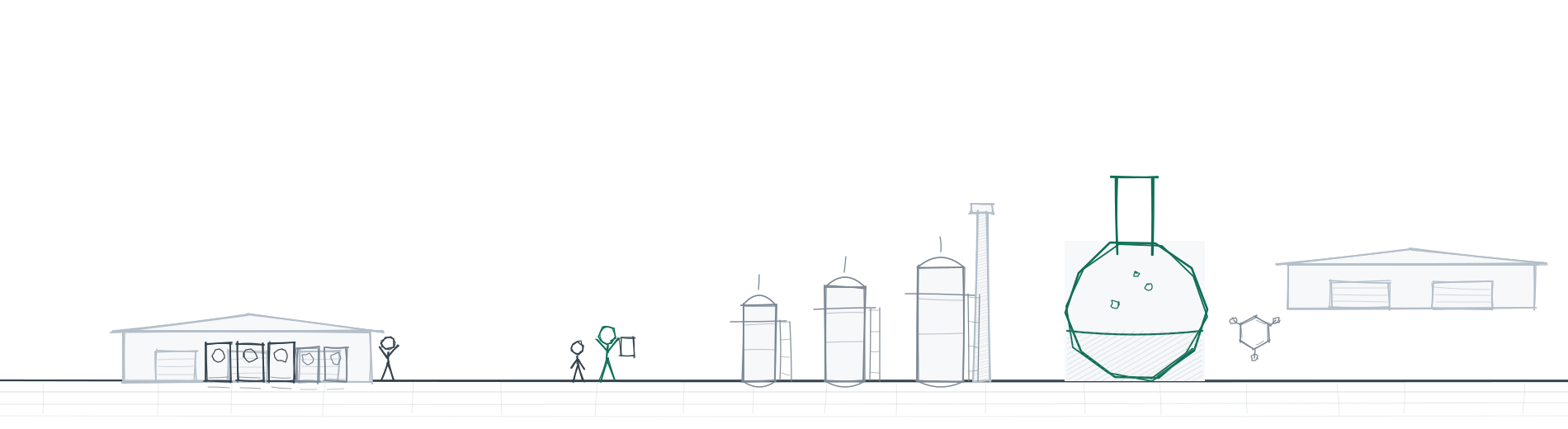
An active pharmaceutical ingredient is not assembled, it is synthesised. Material is charged, reacted, worked up, isolated and dried, usually across several stages, and what comes out is whatever the chemistry gives back that day. India is now building more of that chain at home: the Production Linked Incentive scheme exists precisely to bring Key Starting Materials and intermediates onshore. That shift is what makes the system question urgent. ERPNext for an API or bulk drug plant is judged on whether it can hold a multi-stage chain honestly, cost each stage on real yield and recovery, and answer the reporting that a regulated customer or an incentive claim puts in front of you.
What API and bulk drug manufacturing demands of a system
Start with the chain, because the API is the end of it, not the whole of it. A KSM becomes an intermediate, that intermediate becomes another, and several stages later you have the API. Each stage has its own charge, its own reaction, its own isolation and its own yield, and the output of one is the input of the next. The system has to model that chain as stages rather than a single conversion, because the true cost and the true capacity of the API are the accumulation of every stage beneath it.
The second is that yield compounds, and it is unforgiving. Five stages running at ninety percent each do not deliver ninety percent, they deliver about fifty-nine. A two-point improvement at an early stage is worth far more than the same improvement at the last, and a quiet slip anywhere upstream shows up as a costing mystery at the end. The system has to record actual yield at every stage against a standard, because a plant that only measures the final step cannot tell you where its margin went.
The third is what the chain has to prove. A regulated customer or a filing wants genealogy: which lot of KSM, through which intermediate batches, produced this API batch, with the recovered solvent accounted for rather than quietly ignored. If you also hold a PLI approval, the incentive is claimed against sales of a specific product, which means product-level sales evidence has to come out of the same system that made the material. The system has to carry genealogy across stages and produce that evidence, because both a regulator and a claim are asking you to prove a chain, not assert a total.
A chain modelled as stages
KSM to intermediate to API held as distinct stages, each with its own charge, reaction, isolation and yield, so cost and capacity build up from what actually happens.
Yield recorded at every stage
Actual against standard at each step, not just the final one, because yield compounds and an early loss is worth several times a late one.
Genealogy across the whole chain
Which KSM lot, through which intermediates, made this API batch, with recovered solvent valued and loss booked as loss.
Evidence a claim can rest on
Product-level output and sales that can support a PLI claim or a customer audit, drawn from the records that made the material.
How we deliver API and bulk drug plants on ERPNext
We start with the stage model and yield, because on a synthesis chain they are the business. Each stage as its own step with its own charge, output and actual yield, and the intermediate treated as a real stocked item rather than a number inside a formula. This looks like configuration and it is the whole point: collapse a five-stage synthesis into one conversion and you will never locate the stage that is costing you money.
Then genealogy, recovery and evidence: the trail from KSM lot to API batch, recovered solvent valued back into stock, loss booked as loss, and product-level reporting a customer audit or an incentive claim can stand on. The reporting is only worth trusting once the stages and yields beneath it are captured as the campaign runs, because a yield report is only as honest as the balance it is drawn from.
The chain, stage by stage
| Stage | What happens | What the system has to hold |
|---|---|---|
| Key starting material | The commodity input, bought or increasingly made onshore under PLI. | Stocked and lot-controlled, because everything downstream traces back to this lot. |
| Intermediate stages | One or more isolated intermediates, each a real material with its own yield. | Held as stocked items with their own stage yield, not buried inside one formula. |
| API stage | Final reaction, isolation, drying and milling to specification. | Batch genealogy back through every intermediate, with quality release against spec. |
| Recovery and loss | Solvent recovered and re-used; the rest leaves as effluent. | Recovered solvent valued back into stock, loss booked as loss, so yield and cost stay honest. |
We prove the stage model and yields on a live campaign before building cost reports on them, because on a multi-stage chain a wrong stage boundary quietly misprices everything downstream. In bulk drugs the chain is modelled early, because you cannot reconstruct where a yield went after the solvent has been recovered and the effluent has gone.
Make it or buy it? The question the chain is really asking
Buying the intermediate is simple to run and simple to cost: a purchase price, a lead time, and a supplier who may be in another country. The exposure is that the price and the availability are not yours to control, which is the precise vulnerability the PLI scheme was created to address.
Making it moves the cost inside your walls, where it becomes yield, utilities, solvent recovery and effluent rather than an invoice. That is usually cheaper and always more controllable, but only if you can see it. A plant that backward-integrates without stage-level yield and cost has not reduced its risk, it has only made its cost harder to read. Our Ankleshwar page covers the process-chemistry side of this in more depth.
Are you ready? A short readiness check
- Is each stage of your synthesis a distinct step in the system, or is the whole route one conversion?
- Do you record actual yield against a standard at every stage, or only at the final one?
- Are isolated intermediates stocked and lot-controlled in their own right?
- Can you trace an API batch back through its intermediates to the KSM lot that started it?
- Is recovered solvent valued back into stock, with genuine loss booked as loss?
Four or five clear answers means your chain is visible and the work is refinement. Two or fewer means the first phase is the stage model and stage yields, and on a compounding chain that is the difference between knowing where your margin goes and discovering at year end that it went somewhere.
Frequently asked questions
Why model each stage separately instead of one bill of materials?
Because yield compounds. If the route is one conversion, a loss at stage two and a loss at stage five look identical in the accounts, when in reality the early loss is worth several times more. Stages also let you stock and sell an intermediate, which many plants do.
Can ERPNext handle a variable yield rather than a fixed recipe?
Yes. Each stage plans against a standard yield but records its actual, and the batch is reconciled as a balance of inputs against product, recovered solvent and loss, which is how a reaction behaves rather than how an assembly behaves.
How does genealogy work across several stages?
Each stage links its output batch to the input batches it consumed, so an API batch can be traced back through every intermediate to the originating KSM lot, and forward from any lot to everything it ended up in.
We hold a PLI approval. Does that change the implementation?
It adds a reporting requirement. The incentive is claimed against sales of a specific approved product, so product-level output and sales evidence has to be clean and traceable to the material you actually made. It is far easier to design that in than to reconstruct it at claim time.
How long does an ERPNext implementation take for an API plant?
Twelve to twenty weeks for a multi-stage plant, because the stage model, yields, genealogy and recovery all have to be built and proven on a live campaign. A single-stage or toll-manufacturing operation is faster; the number of stages and the recovery loops are what extend it.
Key takeaways
- An API is the end of a chain, not a single conversion. Model KSM, intermediates and API as distinct stages or you cannot see your own cost.
- Yield compounds. Five stages at ninety percent return about fifty-nine, so an early loss is worth far more than a late one.
- Backward integration under PLI moves cost inside your walls, where it becomes yield and recovery. That is only an advantage if you can measure it.
- Genealogy from KSM lot to API batch is what a filing, a customer audit and an incentive claim all actually ask for.
Planning ERPNext for an API or bulk drug plant?
Start with a team that will model your synthesis chain and stage yields before it prints a cost report. KlyONIX Tech™ is a Frappe Certified Partner working with bulk-drug, intermediate and chemical manufacturers across India.
The Department of Pharmaceuticals operates a Production Linked Incentive scheme for domestic manufacture of critical Key Starting Materials, drug intermediates and Active Pharmaceutical Ingredients, with an outlay of Rs 6,940 crore across 41 identified products spanning fermentation-based and chemical synthesis routes; the scheme responds to an import concentration for critical inputs widely reported at roughly 65 to 70 percent from a single source country. Source checked July 2026.
ERPNext for Pharmaceutical · ERPNext for pharma formulations · ERPNext in Ankleshwar · ERPNext in Hyderabad