ERPNext Implementation in Chennai
Customer schedules, delivery performance, batch traceability and export documentation, configured for Chennai auto component suppliers and export units.
Sector shares and factory count from Guidance Tamil Nadu, the Government of Tamil Nadu investment promotion agency. These are state-wide figures; the Chennai cluster is the largest share of them. Source checked July 2026.
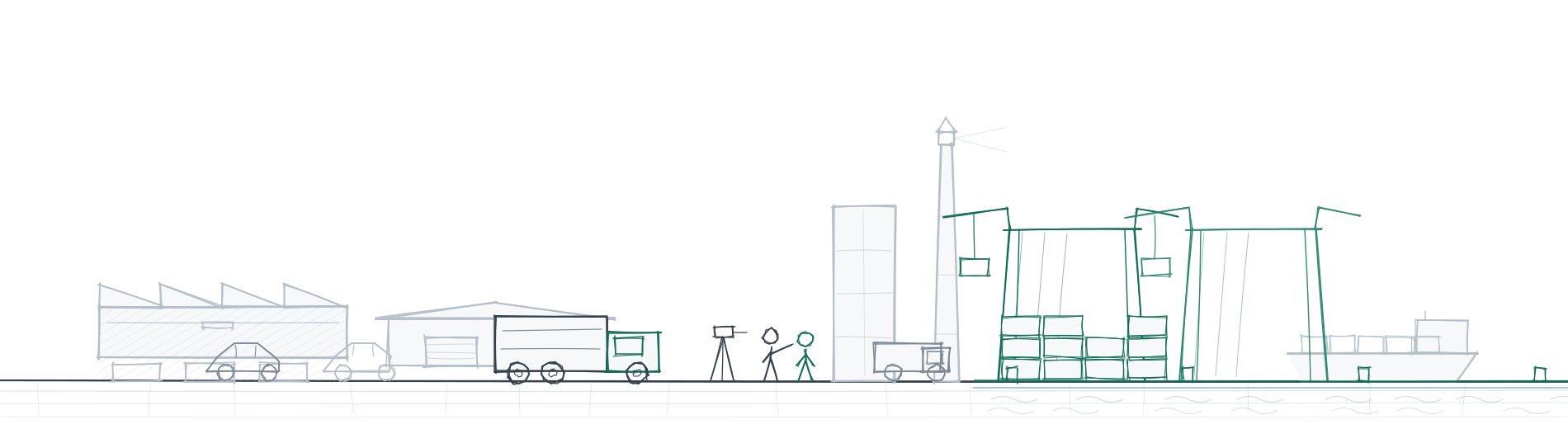
In Chennai you do not run to your own production plan. You run to somebody else’s. A Tier-1 issues a rolling schedule, it moves every week, and your delivery performance against it is measured, scored and discussed in a review you did not call. An ERPNext implementation in Chennai has to make that schedule the centre of the system, because that is where the customer relationship actually lives.
What an ERPNext implementation in Chennai has to solve
Tamil Nadu accounts for about 35% of India’s auto component production across more than 1,500 component factories, and roughly a quarter of India’s four-wheelers are built in the state, with the Chennai cluster at Oragadam, Sriperumbudur and Maraimalai Nagar the largest concentration of it. Around the assembly plants sits a supplier base that is deep, tiered and unusually disciplined about dates.
That discipline is the ERP requirement. A component supplier does not receive orders in any conventional sense. It receives a schedule that commits firm quantities for the near weeks and forecast quantities beyond, and both revise. Treating each revision as a fresh sales order produces a system nobody can reconcile, and treating the forecast as firm produces inventory you cannot sell.
Then there is the paperwork on the way out. Chennai’s two ports move a large share of India’s vehicle and component exports, and an export consignment carries documentation that has to match the goods exactly. When commercial invoice, packing list and shipping bill are assembled by hand from three different files, the error rate is not a possibility, it is a schedule.
Schedules, not one-off orders
A customer schedule is held as a live document with firm and forecast horizons, so a revision updates the plan instead of creating a duplicate order. Your production plan follows the customer’s plan automatically.
Delivery performance you can see first
On-time-in-full measured against the customer’s dates, per part and per period. You walk into the supplier review already knowing the number rather than hearing it.
Traceability to the batch
Lot and batch control through goods receipt, production and despatch, so a field problem can be bounded to the parts actually affected instead of the whole year’s supply.
Export documents from the transaction
Commercial invoice, packing list and the data behind the shipping bill generated from the same despatch record, so the paperwork agrees with the goods without anyone retyping it.
How we deliver in Chennai
We configure the customer-facing end first: how a schedule arrives, how a revision is absorbed, and what a despatch against it looks like. Only then do we work backwards into planning, purchasing and the shop floor. Doing it the other way round produces a tidy internal system that still cannot answer the one question your customer asks.
Multi-plant is the second consideration. Many Chennai suppliers run two or three units across the corridor plus a warehouse near the customer. Stock visibility across those locations, and honest inter-unit transfers, need to be designed rather than discovered.
Typical delivery phases for an ERPNext implementation in Chennai
Supplier businesses cannot pause. This sequence keeps despatch running throughout and puts the customer-facing capability in first.
| Phase | What happens | Why it comes here |
|---|---|---|
| 1. Discovery | Take one customer’s schedule end to end; agree how firm and forecast horizons are held and revised. | Schedule design decides the shape of every downstream transaction, so it is settled before anything is built. |
| 2. Schedules and despatch | Customer schedules, despatch against them, delivery performance reporting. | This is what the customer measures you on, so it earns trust in the project early. |
| 3. Plan and procure | Material planning driven by the schedule, supplier orders, subcontract movement. | Only meaningful once the demand signal upstream of it is real rather than typed in. |
| 4. Costing and finance | Part costing, export documentation, GST, receivables and reporting. | Costing built on clean transactions is defensible; built on estimates it is decoration. |
We do not cut over in a month with a customer audit or a model-year changeover in it. Both consume exactly the people the project needs.
Are you ready? A short readiness check for Chennai suppliers
Work through these five before committing budget to an ERPNext implementation in Chennai. Suppliers who can answer them go live faster, because most delay in an ERP project is decision delay rather than development time.
- Do you know your on-time-in-full number before your customer tells you? If the first you hear of a miss is in the supplier review, that gap is the project’s first job.
- How do you handle a schedule revision today? If a revision means someone edits a spreadsheet and emails it round, expect that habit to fight the system for the first two months.
- Can you trace a despatched part back to its batch? If a customer complaint cannot be bounded, you will end up sorting stock you did not need to sort.
- Is one person accountable for the part master? Auto part numbering sprawls fast across customers and revisions. One owner and a naming rule prevent an unusable catalogue.
- Are your export documents produced from one source? If invoice, packing list and shipping bill data live in three files, reconciliation is a permanent tax on your team.
Four or five clear means you are ready to scope. Two or fewer means start with a short discovery instead of a full implementation.
Frequently asked questions
Can ERPNext handle rolling customer schedules?
Yes. A blanket order with scheduled release quantities holds firm and forecast horizons, and revisions update the same document rather than creating a new order, so planning follows the customer without duplicate paperwork.
Can it report on-time-in-full against customer dates?
Yes, because the promised date and the actual despatch date both sit on the transaction. Performance is reported per part and per period rather than reconstructed at month end.
Does it support multi-plant operations?
Yes. Multiple warehouses and locations sit under one company, with stock visibility across them and inter-unit transfers recorded as real movements rather than adjustments.
How long does an ERPNext implementation in Chennai take?
Ten to eighteen weeks for a single-unit supplier with a defined part list. Multi-plant operations with several customers on different schedule formats take longer, mostly in agreeing how schedules are received.
Is it viable against a licensed ERP the customer already uses?
ERPNext has no per-user licence fee, so cost sits in implementation and hosting rather than seats. What matters commercially is whether it can meet the customer’s data and delivery requirements, which is a configuration question rather than a licensing one.
Key takeaways for Chennai businesses
- The customer schedule, not the sales order, is the centre of a Chennai supplier’s system.
- Know your delivery performance before the supplier review does.
- Batch traceability is what turns a field complaint into a bounded problem instead of an open one.
- Export documents should fall out of the despatch record, not be assembled beside it.
Planning ERPNext for a Chennai supplier or manufacturing unit?
Start your ERPNext implementation in Chennai with a directional cost band based on real scope, users and data condition. Our team reviews every submission and follows up with a tailored view.
Component production share, factory count and four-wheeler share from Guidance Tamil Nadu, the Government of Tamil Nadu investment promotion agency. These are state-wide figures; the Chennai cluster is the largest but not the whole of them. Source checked July 2026.
ERPNext in Hosur · ERPNext in Coimbatore · ERPNext in Trichy · ERPNext implementation cost