ERPNext Implementation in Trichy
Job costing against the drawing, stage inspection gates, milestone billing and a retention register, configured for Trichy fabrication and engineering units.
Plant year, ancillary unit count and employment from the DC-MSME Brief Industrial Profile, Tiruchirappalli, reporting 2015-16 data. These are profile figures, not current-year counts. Source checked July 2026.
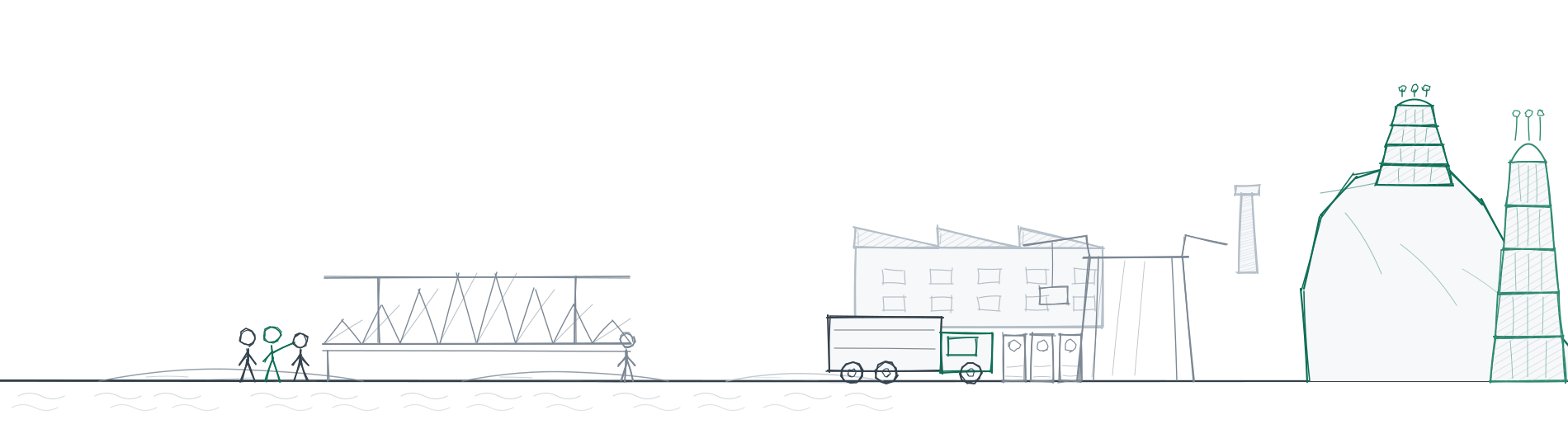
Trichy does not run repetitive manufacturing. It runs projects. A fabrication order arrives as a drawing, the drawing gets revised, each operation waits for a stage inspection before the next one starts, and the money comes in against milestones with retention held back for months after despatch. An ERPNext implementation in Trichy has to model that job, or it will produce a tidy system that describes a business nobody here actually operates.
What an ERPNext implementation in Trichy has to solve
BHEL set up its High Pressure Boiler Plant at Tiruchirappalli in 1961 and deliberately built an ancillary base around it, offloading low and medium technology items to private units. The DC-MSME district profile counts about 400 such units in the Thuvakudi, Ariyamangalam and Thiruverumbur estates, employing close to 18,000 people, alongside roughly 1,787 fabricated metal product enterprises and 1,477 engineering units across the district. HAPP, the Ordnance Factory and the Golden Rock railway workshop add to the same demand pattern.
What all of them share is the shape of the work. A job is quoted against a drawing, material is cut and fitted to that drawing, welds are made to a procedure, and an inspector clears each stage before the job moves on. Nothing about that fits a standard production order with a fixed bill of materials, because the bill of materials changes when the drawing does.
The commercial consequence is the one that hurts. Work in progress sits on the shop floor for weeks, billing happens at milestones rather than at despatch, and five or ten percent of every invoice is held as retention that will only be released after a defect liability period. A business can be profitable on paper and short of cash for the entire year, and most spreadsheets will not show why.
Job costing against the drawing
Material, labour, consumables and subcontract charges are booked to the job rather than to a period. When the drawing is revised, the revision is visible in the cost, so the claim for extra work has evidence behind it.
Stage inspection as a gate
Fit-up, welding, NDT and painting each become a recorded stage with a clearance before the next operation can be booked. Rework stops being invisible and starts being a number you can price.
Milestone billing and retention
Invoices raised against agreed milestones, with retention tracked as a separate receivable and a due date attached. You know at any point how much of your money is sitting with customers rather than in the bank.
Material traceability for inspection
Plate and pipe carry heat numbers and test certificates that a third-party inspector will ask to see. Holding that against the job means the documentation pack is assembled rather than reconstructed under pressure.
How we deliver in Trichy
We configure the job first and the ledger last. The project or work order structure, the stages, and the way a drawing revision is recorded are settled before anything is built, because they determine every transaction that follows. Costing comes next, then billing and retention, then finance.
Subcontracting deserves its own attention here. Machining, galvanising and heat treatment go out and come back, often more than once on the same job. If that movement is not modelled, material appears to vanish and reappear, and the job cost becomes an argument rather than a fact.
Typical delivery phases for an ERPNext implementation in Trichy
Project manufacturing has a natural order. Get the job wrong and everything downstream inherits the error, so the job structure is settled before a single report is designed.
| Phase | What happens | Why it comes here |
|---|---|---|
| 1. Discovery | Walk a live job from enquiry to despatch; agree job structure, stages and drawing revision handling. | Everything downstream inherits the job design, so it is settled before anything is built. |
| 2. Estimation and job costing | Quote build-up, material and labour booked to the job, subcontract in and out. | Costing is the reason for the project, so it proves value early and gets used from week one. |
| 3. Quality stages | Fit-up, welding, NDT and painting recorded as clearances, with traceability to heat numbers. | Needs live job data underneath, and it is what your customer’s inspector will actually test. |
| 4. Billing and finance | Milestone invoices, retention register, GST, receivables and cash position. | Retention and WIP reporting only make sense once the job and the stages behind them are real. |
We avoid going live in the middle of a major delivery commitment. A cutover that collides with an inspection date is remembered for years.
Are you ready? A short readiness check for Trichy fabricators
Work through these five before committing budget to an ERPNext implementation in Trichy. Units that can answer them go live faster, because most implementation delay is decision delay rather than development time.
- Do you know the real cost of a completed job today, including rework? If job cost is worked out after the fact from bills, expect the costing phase to be the longest part of the project.
- Is rework recorded anywhere? If a failed weld is simply redone without a record, the system cannot show you where margin is leaking, and neither can anyone else.
- How are drawing revisions handled commercially? If revised scope is absorbed without a claim, ERP will make the loss visible, which is useful only if someone is going to act on it.
- Do you track retention as money owed? If retention is written off mentally at despatch, you are financing your customers without knowing the amount.
- Who owns the item and operation masters? Fabrication catalogues sprawl fast. One owner with a naming rule prevents an unusable master within a year.
Four or five clear means you are ready to scope. Two or fewer means start with a short discovery instead of a full implementation.
Frequently asked questions
Can ERPNext handle project-based fabrication rather than repetitive production?
Yes. Work orders and projects can be structured per job, with material, labour and subcontract costs booked against that job, which is closer to how a fabrication shop actually operates than a fixed production line.
How are stage inspections recorded?
Quality inspection templates attach to operations, so fit-up, welding, NDT and painting each carry a recorded clearance. The next operation is booked against a job that has already passed the previous stage.
Can retention money be tracked separately?
Yes. Retention is held as a distinct receivable with its own due date rather than being buried in the customer balance, so you can see how much is outstanding and when it falls due.
How long does an ERPNext implementation in Trichy take?
Ten to eighteen weeks for a fabrication unit with defined job stages. Shops running many concurrent jobs with heavy subcontracting take longer, and most of that time is agreeing process rather than writing software.
Is it viable for an ancillary unit with thirty people?
ERPNext has no per-user licence fee, so the cost sits in implementation and hosting rather than seats. Adding shop-floor and quality users later does not increase a licence bill.
Key takeaways for Trichy businesses
- Job costing against the drawing, not period costing, is what makes ERPNext worth doing for a fabricator.
- Unrecorded rework is the most common hidden margin leak in a fabrication shop.
- Retention is your money sitting with someone else. Track it as a receivable with a due date.
- Model subcontract movement properly or job cost becomes an argument rather than a fact.
Planning ERPNext for a Trichy fabrication or engineering unit?
Start your ERPNext implementation in Trichy with a directional cost band based on real scope, users and data condition. Our team reviews every submission and follows up with a tailored view.
Ancillary unit counts, employment and sector figures from the DC-MSME Brief Industrial Profile, Tiruchirappalli, which reports 2015-16 data; BHEL plant history from the BHEL company history. Unit counts are as recorded in that profile, not current-year figures. Source checked July 2026.
ERPNext in Salem · ERPNext in Madurai · ERPNext in Coimbatore · ERPNext implementation cost