ERPNext Implementation in Pune
Make-to-order and make-to-stock planned in one plant, capacity loaded against the real bottleneck, subcontract reconciled and aftermarket margin reported on its own terms.
Sector shares from the Maharashtra Industrial Development Corporation, Government of Maharashtra. These are state-wide figures; the Pune belt is the densest part of them. Source checked July 2026.
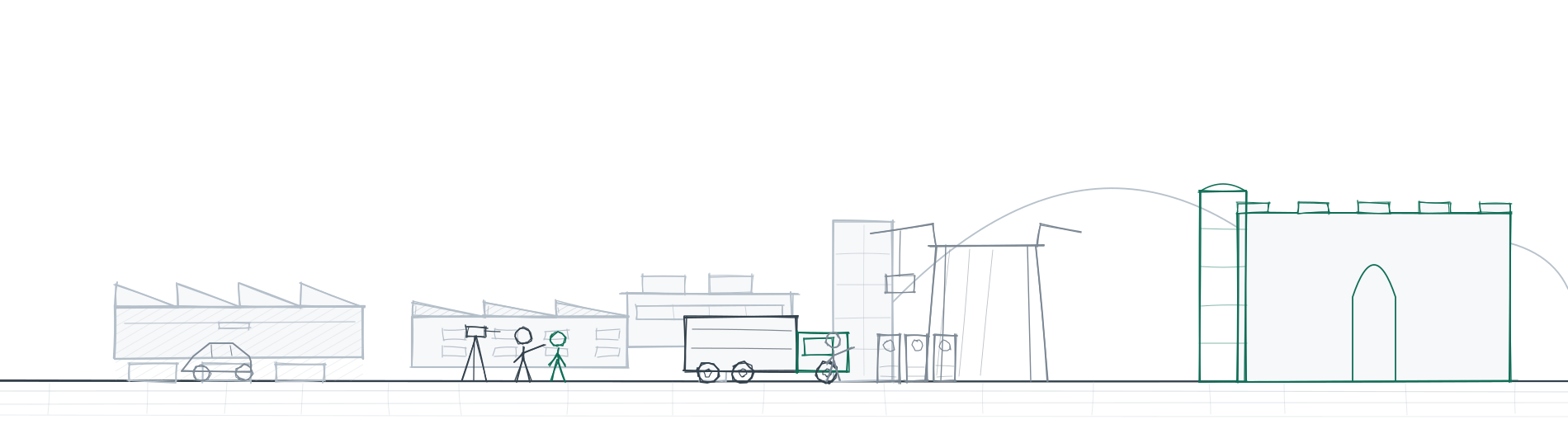
Most Pune plants are running two businesses on one shop floor. One half builds to a customer’s schedule and cannot be late. The other half builds to stock for the aftermarket, spares and export orders, and only earns money if the machines are busy when the first half is not. An ERPNext implementation in Pune has to hold both models honestly, because the fight between them is where capacity and margin are actually lost.
What an ERPNext implementation in Pune has to solve
Maharashtra produces about 23% of India’s automobiles and 23% of its auto components, and the Pune belt through Chakan, Talegaon, Pimpri-Chinchwad and Ranjangaon is the densest part of that. Around the assembly plants sits an unusually broad engineering base: machine tools, hydraulics, castings, forgings and capital equipment, much of it feeding both OEM programmes and independent aftermarket demand.
That mix creates a specific planning problem. Make-to-order work has fixed dates and no flexibility. Make-to-stock work has flexible timing and a replenishment trigger. Run them from one queue and the aftermarket order quietly consumes the capacity the OEM order needed, or the machine sits idle waiting for a schedule that has moved again.
The second issue is where the constraint sits. Most Pune shops have one or two bottleneck machines that determine what the plant can actually deliver. If planning is done on infinite capacity, the plan is a wish. Loading the bottleneck honestly, and telling the customer the truth when it is full, is worth more than any amount of reporting.
Two planning models, one plant
Make-to-order and make-to-stock items configured separately, with reorder levels driving the stock side and customer schedules driving the order side, competing for capacity in a way you can see.
Capacity loaded against the bottleneck
Work centres with real available hours, so a promised date is checked against the machine that actually constrains you rather than assumed to be achievable.
Subcontract movement that reconciles
Heat treatment, plating and machining tracked out and back against the job, so material does not appear to vanish for three weeks and reappear as a mystery.
Aftermarket priced on its own terms
Spares and aftermarket lines carrying their own costing and margin rather than inheriting OEM pricing logic that was negotiated under completely different conditions.
How we deliver in Pune
We separate the two demand streams first, because everything downstream depends on knowing which rules apply to which item. Then work centres and routings, then capacity, then costing. Finance comes last, as always, because a cost report built on a plan nobody follows is decoration.
Multi-plant deserves early attention here too. Many Pune firms run a main unit plus a second plant or a job-work satellite, and inter-unit movement has to be modelled as real transfers. If it is recorded as adjustment, plant-level profitability becomes an argument rather than a number.
Typical delivery phases for an ERPNext implementation in Pune
Planning is the point of this project, so it comes early and finance comes last.
| Phase | What happens | Why it comes here |
|---|---|---|
| 1. Discovery | Separate make-to-order from make-to-stock; identify the bottleneck work centres and how subcontract moves. | Which rules apply to which item decides the shape of every plan the system produces. |
| 2. Planning and capacity | Routings, work centre hours, schedule-driven and reorder-driven demand meeting in one plan. | This is the actual pain, so solving it early earns the project its credibility on the floor. |
| 3. Execution and subcontract | Job cards, actual consumption, out and back subcontract movement, rework capture. | Needs a plan worth executing against, otherwise the floor reverts to the whiteboard. |
| 4. Costing and finance | Part costing, aftermarket margin, inter-unit transfers, GST and reporting. | Costing built on real routings and actual hours is defensible; built on standards alone it is not. |
We keep go-live away from a customer audit or a model changeover. Both take the production engineers the project depends on most.
Are you ready? A short readiness check for Pune manufacturers
Work through these five before committing budget to an ERPNext implementation in Pune. Plants that can answer them go live faster, because most delay in an ERP project is decision delay rather than development time.
- Do you know which machine is your constraint this month? If the answer changes depending on who you ask, capacity planning is the project rather than a module of it.
- Are make-to-order and make-to-stock items distinguished anywhere today? If they share one queue, expect the system to expose how often the aftermarket order won.
- Do you have routings with real cycle times, or estimates from the quotation? Costing accuracy is capped by whichever of those you actually maintain.
- Can you reconcile material at a subcontractor right now? If out and back are tracked on a register, plan for that to be the noisiest part of data migration.
- Is aftermarket margin measured separately from OEM margin? If both sit in one gross figure, you are probably cross-subsidising and cannot prove which way.
Four or five clear means you are ready to scope. Two or fewer means start with a short discovery instead of a full implementation.
Frequently asked questions
Can ERPNext run make-to-order and make-to-stock in the same plant?
Yes. Items can be planned from customer schedules or from reorder levels, and both feed the same production plan, so the two demand streams compete for capacity visibly rather than invisibly.
Does it support finite capacity planning?
Work centres carry available hours and operations carry times, so a schedule can be loaded against real capacity. It is a planning aid rather than an optimiser, and it is honest about when a bottleneck is full.
How is subcontracting handled?
Material issued to a subcontractor stays on your books at a supplier warehouse, and the finished receipt consumes it against the order, so what went out and what came back are reconciled rather than estimated.
Can spares and aftermarket be costed separately from OEM?
Yes. Separate item groups, price lists and cost centres let aftermarket margin be reported on its own terms instead of being blended into programme pricing.
How long does an ERPNext implementation in Pune take?
Ten to twenty weeks for a single plant with defined routings. Plants with heavy subcontracting, a second unit or no maintained cycle times take longer, and most of that is data rather than software.
Key takeaways for Pune businesses
- Make-to-order and make-to-stock are different disciplines. Running them from one queue hides where capacity went.
- Plan against the bottleneck, not against infinite capacity, or the plan is a wish.
- Routings with real cycle times set the ceiling on how accurate your costing can ever be.
- Report aftermarket margin separately, or you will never know which side is subsidising the other.
Planning ERPNext for a Pune manufacturing plant?
Start your ERPNext implementation in Pune with a directional cost band based on real scope, users and data condition. Our team reviews every submission and follows up with a tailored view.
Automobile and auto component production shares from the Maharashtra Industrial Development Corporation, Government of Maharashtra. These are state-wide figures; the Pune belt is the densest part of them, not the whole. Source checked July 2026.
ERPNext in Mumbai · ERPNext in Chennai · ERPNext in Hosur · ERPNext implementation cost