ERPNext Implementation in Sikkim
A national pharma company built a plant in Sikkim for the fiscal incentive, then had to run it at the end of a single mountain road. The medicine is made here and sold the length of India, so the incentive has to be accounted for and every carton has to be despatched, batched and traced out.
Sikkim’s pharmaceutical cluster along the Teesta, at Rangpo and Majitar, grew on the fiscal incentives of the state’s Commerce and Industries policy and the area-based exemptions of the 2000s, and national companies run WHO-GMP formulation plants there. Source checked July 2026.
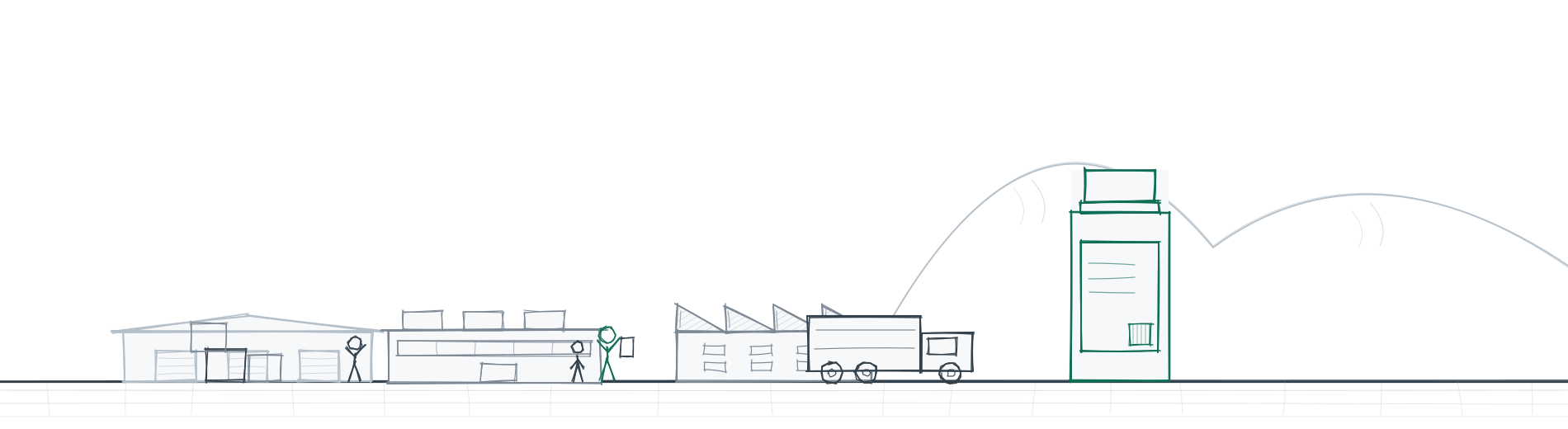
Sikkim’s formulation plants, along the Teesta at Rangpo and Majitar, were built by national pharma companies for the fiscal incentives of the 2000s, and now make finished tablets, capsules and liquids that are sold across India. The plant sits at the end of a single mountain road, far from the markets it supplies, so the work is as much distribution as it is manufacturing. An ERPNext implementation in Sikkim is judged on whether it can account for the incentive the plant was built for, despatch serialized and batch-dated stock to depots and C&F agents across the country, and manage expiry and returns over a national network, not just inside the plant.
What an ERPNext implementation in Sikkim has to solve
Start with the incentive, because it is why the plant is here. The economics of a Sikkim plant rest on the fiscal benefit it was built for, and after GST that flows through a budgetary-support position rather than a simple exemption. The system has to compute and support that position from the actual production and tax records, because a benefit worth a large share of the plant’s margin cannot rest on a spreadsheet a reviewer will not accept.
The second is despatch from a remote plant, because the market is a thousand kilometres away. Finished goods leave a landlocked plant on one road, moving to depots and clearing-and-forwarding agents across India, and every carton is serialized and batch-dated on the way out. The system has to serialize and batch finished goods, hold depot and in-transit stock as its own, and see what has left, what is moving and what has landed, because a plant far from its market lives or dies on getting despatch right.
The third is expiry and returns across the network, because the stock does not stop at the plant gate. Finished medicine sits in depots and with distributors, carrying an expiry, and it has to move oldest-first, be traced to a recall wherever it is, and come back as an expiry return from anywhere in the country. The system has to carry batch and expiry the length of the distribution chain, because expiry managed only inside the plant is expiry not managed at all.
The incentive, accounted for
The fiscal-incentive or budgetary-support position computed and supported from real production and tax records, because it is a large share of the plant’s margin and has to stand up to review.
Serialized despatch from a remote plant
Finished goods serialized and batch-dated on the way out, with depot and in-transit stock held as the plant’s own, so a landlocked plant can see what has left, what is moving and what has landed.
Batch and expiry across the network
Batch and expiry carried the length of the distribution chain to every depot and distributor, moving oldest-first and traceable to a recall wherever the stock has reached.
Returns from anywhere in India
Expiry and recall returns handled from any depot or distributor back to the batch, so stock sold a thousand kilometres away is still accounted for and traced.
How we deliver in Sikkim
We start with despatch, serialization and the incentive position, because for a Sikkim plant they are the business. Finished goods serialized and batch-dated, depot and C&F stock held as the plant’s own, and the fiscal-incentive or budgetary-support position computed from real records. This looks like configuration and it is the whole point: run a remote plant on plant-gate stock and a hand-worked incentive and you will lose sight of your goods and your margin at the same time.
Then expiry and returns across the network: batch and expiry carried to every depot, oldest-first despatch, and returns traced from anywhere back to the batch. Reporting on the incentive, on stock in the field and on expiry comes once despatch and batch beneath them are captured honestly, because you cannot report on stock you stopped tracking at the gate.
Typical delivery phases for a Sikkim implementation
| Phase | What happens | Why it comes here |
|---|---|---|
| 1. Discovery | Map how the fiscal-incentive position is worked today, how finished goods are serialized and despatched, how depot and C&F stock is held, and how expiry and returns run across the network. | A remote incentive-zone plant is unlike a plant near its market. Assuming plant-gate stock and a hand-worked incentive would lose both the goods in the field and the margin. |
| 2. Despatch and serialization | Finished goods serialized and batch-dated on despatch, with depot and in-transit stock held as the plant’s own. | Despatch and stock visibility are the foundation for a plant far from its market, so they are built before expiry, returns or the incentive report mean anything. |
| 3. Batch, expiry and returns | Batch and expiry carried to every depot, oldest-first despatch, and expiry and recall returns traced from anywhere back to the batch. | Needs trustworthy despatch and stock underneath before expiry across a national network can be believed. |
| 4. Incentive and reporting | The fiscal-incentive or budgetary-support position computed from real production and tax records, and reporting on stock in the field and on expiry. | The incentive and the field reports are only worth trusting once despatch, batch and stock beneath them are captured as the work is done. |
We prove despatch, serialization and the incentive position on live stock before trusting them, because for a remote plant a lost carton or a shaky incentive claim is discovered at a stock count or a review, when it is expensive. In Sikkim the despatch and the incentive are proven early, because a plant this far from its market cannot afford to guess where its goods or its margin are.
Are you ready? A short readiness check
- Is your fiscal-incentive or budgetary-support position computed from real records, or worked by hand?
- Is finished stock serialized and batch-dated on despatch from the plant?
- Do you hold depot and in-transit stock as your own, and see what has left, is moving and has landed?
- Is batch and expiry carried to every depot, and does despatch move oldest-first?
- Can you trace and take back an expiry or recall return from anywhere in the country?
Four or five clear answers means you mostly need a system that keeps a discipline your plant and distribution already run. Two or fewer means the first phase is despatch, serialization and the incentive, and for a remote plant that is the difference between a margin and a stock position you can prove and ones you hope are right.
Frequently asked questions
Can ERPNext account for a Sikkim plant’s fiscal incentive?
Yes. The fiscal-incentive or post-GST budgetary-support position is computed and supported from real production and tax records, so the benefit that carries much of the plant’s margin rests on the system rather than a spreadsheet.
How does it handle despatch from a remote, landlocked plant?
Finished goods are serialized and batch-dated on despatch, and depot and in-transit stock is held as the plant’s own, so a plant far from its market can see what has left, what is moving and what has landed at each depot and C&F agent.
Can it manage batch and expiry across a national network?
Yes. Batch and expiry are carried the length of the distribution chain, despatch moves oldest-first, and any batch is traceable to a recall wherever the stock has reached.
Can it handle expiry and recall returns from across India?
Yes. An expiry or recall return is handled from any depot or distributor back to the specific batch, so stock sold a thousand kilometres away is still traced and accounted for.
How long does an ERPNext implementation take for a Sikkim formulation plant?
Ten to eighteen weeks for a formulation plant with national distribution, because despatch, serialization, depot stock, expiry and the incentive position all have to be modelled and proven. A single-location plant is faster; the distribution depth is the variable, not the software.
Key takeaways for Sikkim businesses
- In Sikkim the plant exists for the fiscal incentive, so the incentive or budgetary-support position has to be computed and supported from real records, not worked by hand.
- The market is a thousand kilometres away on one road, so serialized, batch-dated despatch and visible depot and in-transit stock are the business, not an afterthought.
- Stock does not stop at the gate. Carry batch and expiry to every depot, despatch oldest-first, and handle returns from anywhere in the country.
- Prove despatch and the incentive on live stock early, because a remote plant cannot afford to guess where its goods or its margin are.
Planning ERPNext for a Sikkim formulation plant?
Start your ERPNext implementation with a team that will build your despatch, serialization and incentive position before it prints a report. KlyONIX Tech™ is a Frappe Certified Partner with offices in Pollachi and Chennai, working with pharmaceutical and manufacturing businesses across Sikkim and the North East.
Sikkim’s pharmaceutical cluster, at Rangpo and Majitar along the Teesta, grew on the fiscal incentives of the state’s Commerce and Industries policy and the area-based exemptions of the 2000s, and national companies run WHO-GMP formulation plants there for tablets, capsules and liquids distributed across India. Source checked July 2026.
ERPNext in Baddi · ERPNext in Ankleshwar · ERPNext in Kolkata · ERPNext implementation cost