ERPNext for Pump and Motor Manufacturers
Every pump that leaves a Coimbatore plant carries two promises: a performance curve from the test bench and a warranty that follows it into a farmer's field. Pump manufacturing is won or lost on whether you can stand behind both.
Book a free 30-minute consultation
Coimbatore cluster figures as cited by the Coimbatore District Administration and published industry reporting: the region supplies over 40% of India's pump and motor requirement, with about 3,000 pump and motor component enterprises. Source checked October 2026.
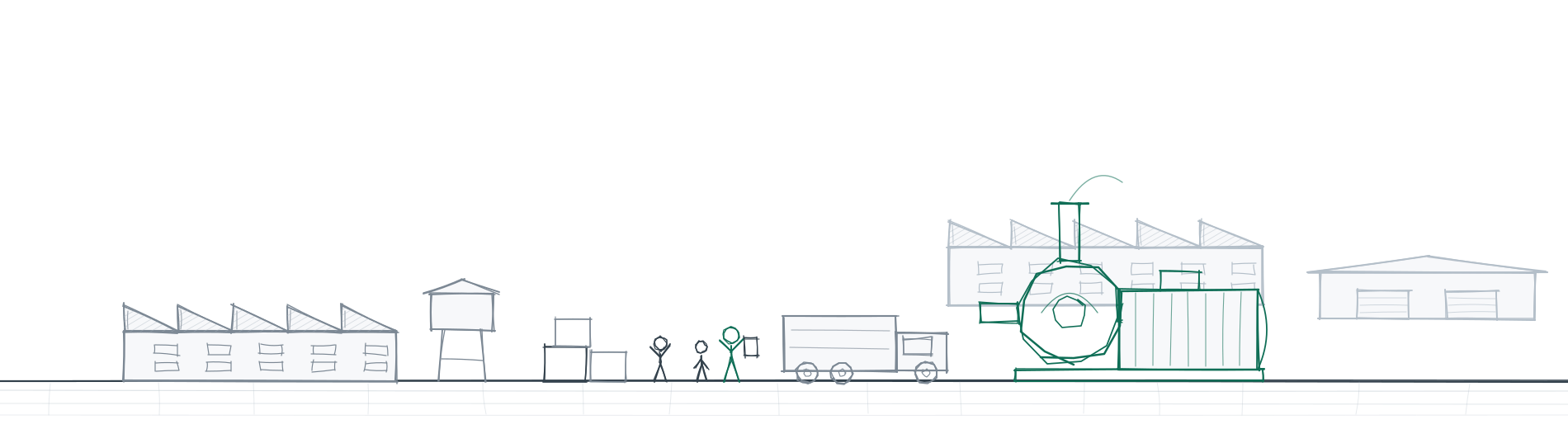
Pump manufacturing looks like simple assembly from the outside: castings, a shaft, an impeller, a wound motor, a body and a box. Inside, it is hundreds of models across power ratings, stages, voltages and phases, castings bought from foundries and machined by job workers, copper whose price moves every week, a test bench that has to certify every unit, and a dealer network that sells most of the year's volume in a few months before and during the monsoon. ERPNext for pump manufacturing is judged on whether it can hold all of that in one system without turning every new model into a new spreadsheet.
What pump manufacturing needs that a generic ERP does not
Start with the model range. A single product family can run into hundreds of variants: kW and HP rating, number of stages, single or three phase, voltage band, cable length, pipe size. If each variant is set up by hand, the item master becomes the bottleneck and costing becomes guesswork. The system has to treat the family as one template with controlled variants, each carrying its own bill of materials.
The second is the test bench. Each pump is tested for head, discharge, current and efficiency before dispatch, and that result is the evidence behind the nameplate, the BIS certification and any energy label. If the test record lives in a register next to the bench, it cannot be found when a warranty claim arrives two years later. The system has to tie the test record to the serial number, and the serial number to the invoice and the dealer.
The third is the supply side. Castings come from foundries, machining often goes out as job work, and winding copper is the single most volatile cost in the product. The system has to track castings and job-work stock at outside units, and value copper honestly, because a costing built on last quarter's copper price quietly sells this quarter's pumps at a loss.
Model variants without chaos
Item templates hold the pump family, with kW, stages, phase and voltage as controlled variants, each with its own bill of materials and price.
Serial-wise test certificates
Head, discharge, current and efficiency from the test bench recorded against each serial, printed on the certificate and retrievable years later.
Castings and machining job work
Castings received from foundries and machining sent to job workers tracked as stock at each outside unit, with rejections and returns reconciled.
Warranty by serial and dealer
Every claim traced from the serial to the invoice, the dealer and the test record, so genuine failures and misuse are separated quickly.
How we deliver pump manufacturing on ERPNext
We start with the item structure, because everything else depends on it. Pump families become item templates, ratings and configurations become variants, and bills of materials are built once per configuration rather than once per invoice. Done properly, a new model takes minutes to set up and arrives with its cost already worked out.
Then production, testing and the channel: work orders that consume the right castings, windings and bought-out parts, a test step that records the bench result against the serial before the unit can be dispatched, and dealer sales, schemes and warranty claims handled against the same serial. For groups that also run a foundry, our ERPNext for foundry page covers the casting side.
A pump's journey from casting to customer
| Stage | What happens | What the system has to hold |
|---|---|---|
| Planning | Seasonal forecasts and dealer orders set the build plan for each model. | Demand by model and region, worked back into castings, copper and bought-out parts with their lead times. |
| Castings and machining | Castings arrive from foundries and go out for machining. | Castings and machined parts tracked at each outside unit, with rejections returned and reconciled. |
| Winding and assembly | Motors are wound and pumps assembled against work orders. | Copper consumption by work order, sub-assemblies by serial, and actual cost per unit. |
| Testing | Each pump is tested on the bench for head, discharge, current and efficiency. | The test record stored against the serial, with failed units held back from dispatch. |
| Dealers and warranty | Pumps are sold through dealers, and claims come back during the season. | Invoices, schemes and warranty claims linked to the serial, the dealer and the original test record. |
We usually go live with item variants, bills of materials, purchase and production first, then add the test step and serial tracking, then the dealer and warranty side. Serial tracking added before the item master is clean only multiplies the mess.
Make-to-stock for the season, or make-to-order for projects? It changes the build
Most agricultural and domestic pump makers build to stock for the season. The priority is forecasting by model and region, castings and copper planned against lead times, and a dealer channel with schemes and warranty. That is the Coimbatore pattern, and our Coimbatore page covers the local context.
Industrial and project pump makers build to order against a specification, often with documents and inspection for each job. There the priority is order-wise bills of materials, project costing and inspection records, closer to engineer-to-order manufacturing than to a seasonal channel business.
Are you ready? A short readiness check
- Is every pump model and variant set up with its own bill of materials, or costed from a rule of thumb?
- Can you find the bench test result for a serial number sold two years ago?
- Do you know how many castings and machined parts are sitting with each job worker today?
- Is copper cost updated in your costing as the price moves?
- Can a dealer's warranty claim be checked against the serial, invoice and test record in minutes?
Four or five clear answers means the operation is already disciplined and ERPNext will mostly remove manual work. Two or fewer means the first phase should be the item structure and serial tracking, because that is the foundation everything else in pump manufacturing sits on.
Frequently asked questions
Is ERPNext suitable for pump manufacturing?
Yes. Item variants, bills of materials, work orders, subcontracting, serial number tracking, quality inspection and warranty claims are standard in ERPNext, and they map closely to how pump and motor manufacturers work.
Can ERPNext store test certificates for each pump?
Yes. A quality inspection or a custom test record can capture head, discharge, current and efficiency against each serial number, block dispatch of failed units and print the certificate with the pump.
How does ERPNext handle hundreds of pump models?
Through item templates and variants. A pump family is set up once, with rating, stages, phase and voltage as attributes, and each variant carries its own bill of materials and price, so new models do not mean new spreadsheets.
Can it manage dealers, schemes and warranty claims?
Yes. Dealer orders, discounts and schemes are handled in selling, and warranty claims are logged against the serial number, so each claim can be checked against the invoice and the original test result.
How long does an implementation take for a pump manufacturer?
A typical rollout takes ten to sixteen weeks, depending on the number of models, outside job workers and how clean the existing item master is. Cleaning the item master is usually the longest single task.
Key takeaways
- Pump manufacturing runs on a large model range. Item templates and variants are the foundation, not an afterthought.
- Tie every bench test to a serial number so certification and warranty decisions rest on evidence.
- Track castings and machining at outside units, and keep copper costs current, or margins slip without anyone noticing.
- Seasonal demand through dealers needs planning by model and region, worked back to lead times on castings and copper.
Planning ERPNext for a pump or motor manufacturer?
Talk to a team based in the Coimbatore belt that understands castings, winding, test benches and dealer seasons. KlyONIX Tech is a Frappe Certified Partner implementing ERPNext since 2017.
Book a free 30-minute consultation or estimate your ERPNext cost
Cluster figures as cited by the Coimbatore District Administration and published industry reporting: Coimbatore supplies over 40% of India's pump and motor requirement, with about 3,000 pump and motor component enterprises in the region. BEE star labelling for pump sets is currently in the voluntary phase of the Bureau of Energy Efficiency programme; BIS standards such as IS 8034 apply to submersible pumpsets. Source checked October 2026.
ERPNext for Manufacturing · ERPNext in Coimbatore · ERPNext for foundry · ERPNext manufacturing module · ERPNext v16 for manufacturers