ERPNext Implementation in Ludhiana
A finished bicycle is a few hundred parts, and most of them are made by somebody else in the same town. The hard part is not building one; it is being able to build one when every part comes from a different small unit.
Enterprise count from the MSME district industrial profile of Ludhiana (Development Commissioner, Ministry of MSME). The bicycle and woollen-knitwear shares are widely reported industry figures for what is long known as India’s bicycle capital. Source checked July 2026.
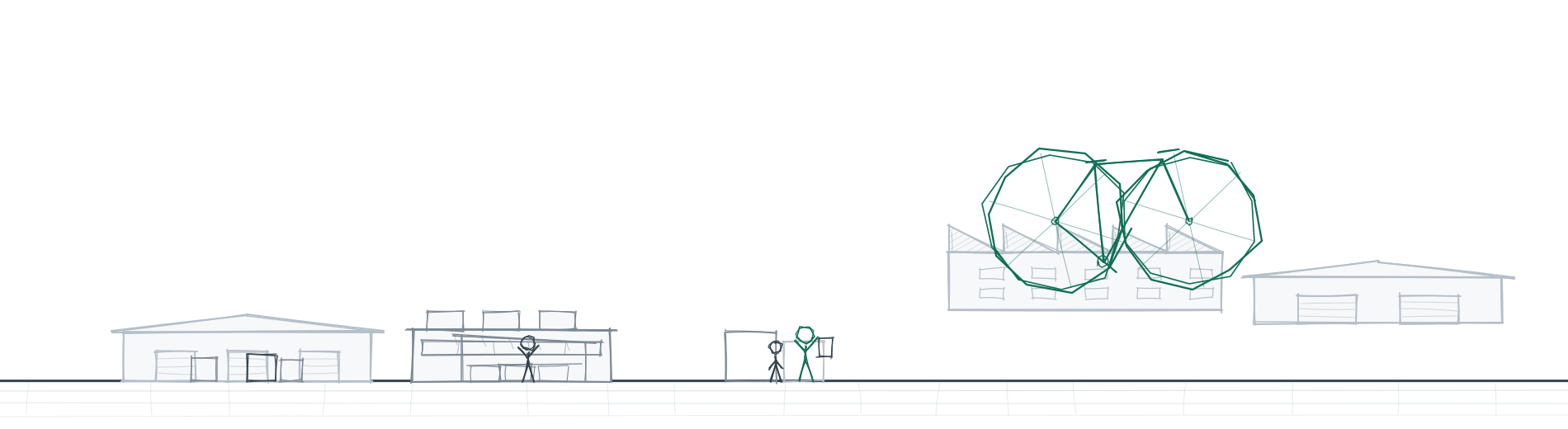
Ludhiana is a town built like a supply chain. Its roughly fourteen thousand manufacturing units, on the MSME district profile, make more than half of India’s bicycles, most of its cycle parts, around ninety per cent of its woollen knitwear, and a great share of the country’s hand tools, fasteners, sewing machines and auto components. The defining feature is not the size of any one factory; it is that a finished product is assembled from hundreds of parts made by hundreds of small units. An ERPNext implementation in Ludhiana is judged on whether it can hold that whole tree of parts and let you build a finished product when every piece of it lives with a different vendor.
What an ERPNext implementation in Ludhiana has to solve
Start with the bill of materials, because the product is a tree, not a list. A bicycle is frames, forks, rims, hubs, chains, brakes and a hundred fasteners, and many of those are themselves sub-assemblies. A flat list of parts cannot plan a build; a multi-level bill of materials that mirrors how the thing is actually put together can. Until the system holds the product the way the floor builds it, planning is guesswork dressed as a spreadsheet.
The second is where every part comes from, because in Ludhiana most of them come from outside. Each component is made in-house, bought finished, or sent out as job-work to one of the small units around you, and the plan has to know which. Material issued to a job-work unit has to be reconciled against what comes back, by quantity and by scrap, so the network of suppliers sits on the books rather than on paper chits that reconcile at nobody’s desk.
The third is the discipline of not starting what you cannot finish. A bicycle held up for one bracket from one of two hundred vendors is capital lying on the floor. The system has to check that a build is actually kitted, that every component is available, before assembly begins, and to make a shortage visible early rather than at the moment the line stops. Get that right and the town’s scatter of units becomes an assembly line you can actually schedule.
A multi-level bill of materials
The finished product held as the tree it really is, sub-assemblies and components and raw beneath it, so a bicycle or a sewing machine is planned the way the floor builds it rather than as a flat list.
Make, buy or subcontract, per part
Every component tagged as made in-house, bought finished, or sent out as job-work, so planning knows where each of the hundreds of parts is coming from and when.
Job-work issued and reconciled
Raw and semi-finished issued to the small units around you and reconciled on return by quantity and scrap, so the supplier network is on the books rather than on chits nobody balances.
Kit before you build
A shortage check before assembly starts, so a finished product is not left half-built and blocking capital while it waits on one part from one of many vendors.
How we deliver in Ludhiana
We start with the bill of materials and the sourcing tag on every part, because that is the spine of the whole thing. The multi-level tree that mirrors the real build, and each component marked make, buy or subcontract, so planning and purchasing and job-work all read from one structure. This looks like data entry and it is the project: a plan built on a flat or half-right BOM will promise builds the floor can never kit.
Then the network and the assembly: material issued to job-work units and reconciled on return, a kit and shortage check before a build begins, and a rolled-up cost per finished product that carries the whole tree, subcontract and scrap included. Reporting on shortages, on job-work reconciliation and on true product cost comes once the BOM and the sourcing beneath it are honest.
Typical delivery phases for a Ludhiana implementation
| Phase | What happens | Why it comes here |
|---|---|---|
| 1. Discovery | Map how deep the bills of materials go, which parts are made, bought or subcontracted, how job-work is issued and returned, and how shortages are handled today. | Every product and every vendor network is structured differently. Assuming a flat BOM or an in-house build would misplan the entire assembly. |
| 2. BOM and sourcing | Multi-level bills of materials that mirror the real build, with each component tagged make, buy or subcontract. | Planning, purchasing and job-work all read from this one structure, so it is built and agreed before anything is scheduled. |
| 3. Subcontract and assembly | Material issued to job-work units and reconciled on return, and a kit and shortage check before each build begins. | Needs a trustworthy BOM and sourcing underneath before issue, reconciliation and kitting mean anything. |
| 4. Cost and margin | A rolled-up cost per finished product across the whole tree, subcontract and scrap included, and reporting on shortages and reconciliation. | Cost and shortage reporting are only worth trusting once the structure and the network beneath them are captured honestly. |
We prove the job-work reconciliation and the kit check on live builds before trusting them, because a plan that promises bicycles it cannot kit is worse than an honest backlog. In a town where the assembly line is spread across hundreds of units, the network has to be on the system before the schedule can be believed.
Are you ready? A short readiness check
- Is your product held as a multi-level bill of materials, or as a flat list of parts?
- For each part, do you know whether it is made in-house, bought, or subcontracted?
- When you issue material to a job-work unit, is what comes back reconciled by quantity and scrap?
- Before you start an assembly, do you check that every component is actually available?
- Does the cost of a finished product roll up the whole tree, including subcontract and scrap?
Four or five clear answers means you mostly need a system that keeps a discipline you already run across your vendors. Two or fewer means the first phase is the bill of materials and the job-work network, and in this town that is the difference between a schedule you can build to and a floor full of half-finished product.
Frequently asked questions
Can ERPNext hold a multi-level bill of materials for a bicycle or sewing machine?
Yes. The finished product is held as a tree of sub-assemblies, components and raw material, so it is planned the way it is actually built rather than as a flat list, and a change deep in the tree flows up to the finished good.
How does it handle the job-work network?
Each part is tagged make, buy or subcontract, and material sent to a job-work unit is issued and then reconciled on return by quantity and scrap, so the hundreds of small units that feed your assembly sit on the books rather than on paper.
Can it stop a build starting without all its parts?
Yes. A kit or shortage check before assembly confirms every component is available, so a finished product is not left half-built and blocking capital while it waits on one part from one supplier.
Does it cover the knitwear side of the business too?
Yes. Woollen and cotton hosiery is handled as its own flow with seasons, sizes and its own job-work, and many Ludhiana groups run both engineering and knitwear, which ERPNext keeps as separate businesses under one set of books.
How long does an ERPNext implementation take in Ludhiana?
Ten to eighteen weeks for an assembler with a real subcontract network, because the multi-level BOM and the job-work reconciliation have to be built and proven. A single-product shop is faster; the depth of the BOM and the network is the variable, not the software.
Key takeaways for Ludhiana businesses
- In Ludhiana the town is the assembly line. A finished product is hundreds of parts made by hundreds of units, so the system has to hold the whole tree.
- Hold a multi-level bill of materials that mirrors the real build, not a flat list, or planning is guesswork.
- Most parts are subcontracted. Issue material to job-work units and reconcile the returns, or the network lives on chits that never balance.
- Kit before you build. A finished product blocked on one part from one of two hundred vendors is capital lying on the floor.
Planning ERPNext for a Ludhiana bicycle, parts or knitwear business?
Start your ERPNext implementation with a team that will build your bill of materials and your job-work network before it schedules a single build. KlyONIX Tech™ is a Frappe Certified Partner with offices in Pollachi and Chennai, working with manufacturers across Punjab and north India.
The figure of about fourteen thousand manufacturing MSMEs is from the MSME district industrial profile of Ludhiana published by the Development Commissioner, Ministry of Micro, Small & Medium Enterprises. Ludhiana’s standing as India’s bicycle capital, producing more than half the country’s bicycles and most of its cycle parts, and around ninety per cent of India’s woollen knitwear, are widely reported industry figures. Source checked July 2026.
ERPNext in Delhi NCR · ERPNext in Chennai · ERPNext in Tiruppur · ERPNext implementation cost